
Preserving Brighton’s Agricultural Heritage
Hops Barn in Brighton ~ Relocating to Codrington Beginning July 2024
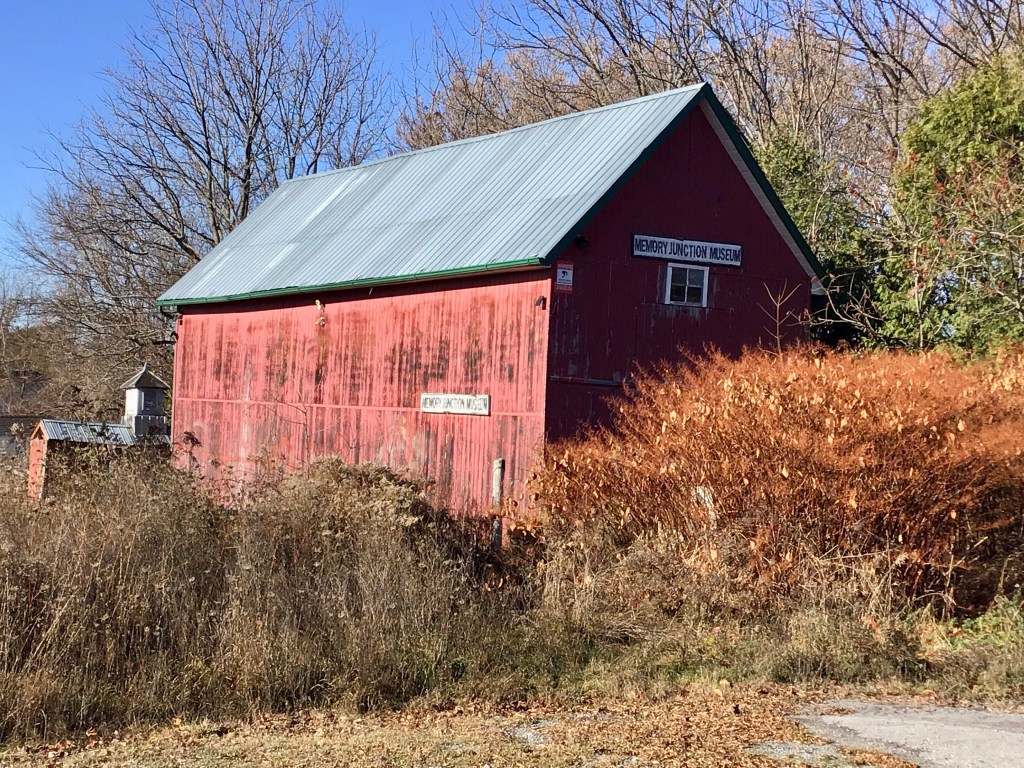
A bit of Brighton’s history is about to be preserved. The hops barn that was built in 1880 and moved to Memory Junction (across from Northumberland Fine Food) in 2002 is about to be re-located to Codrington. The work has just recently begun.
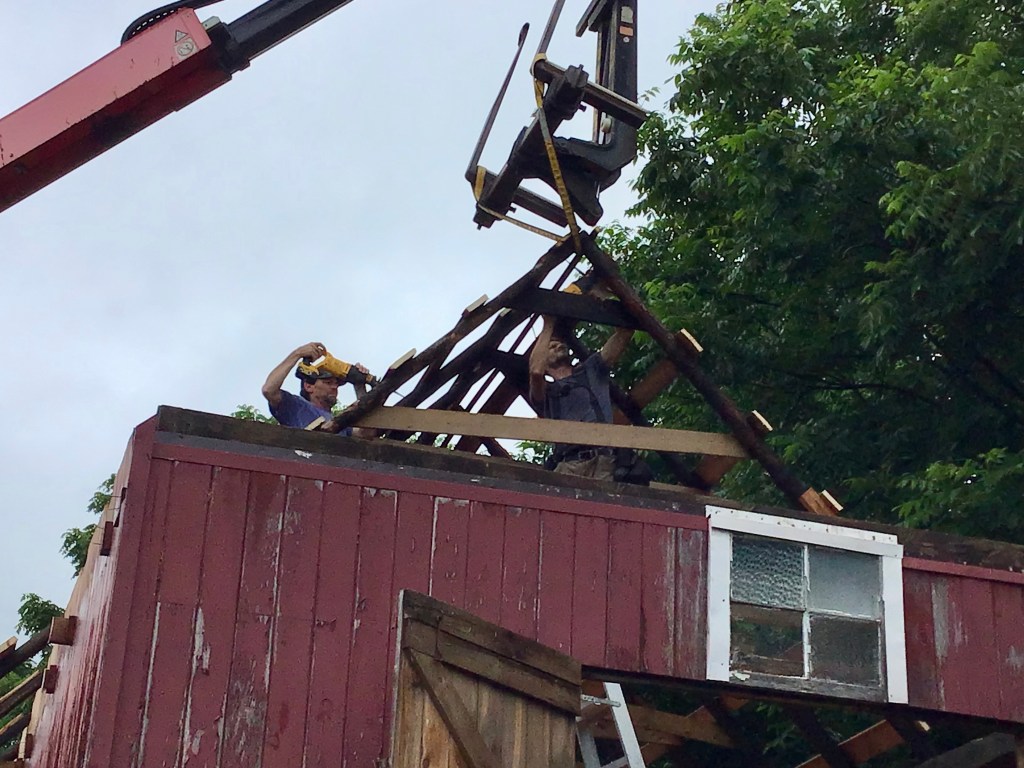
As the barn’s journey unfolds, you are invited to share any information you might have about this busy time in Brighton’s past via email (Contact Us) or Facebook (/BrianToddMCF).
Historical Background of the Hops Industry in Brighton
1️⃣ PRESERVING BRIGHTON’S HERITAGE IN 2024

In 1880, two 23 year old farmers built a hops kiln/barn east of Smithfield to support a busy hops industry in the Brighton area – more than 30 local farmers grew hops in those years. For about 25 years, it was used to dry hops before it was shipped to upstate New York to be used in the production of beer. After the hops industry dried up in the early 1900’s (not because beer became unpopular, but because of the introduction of high U.S. tariffs), the kiln was removed and the barn continued to be used to support general farming activities. In 2002, a fourth generation hops grower named Basil McMaster had the barn dismantled and moved to the Memory Junction Museum in Brighton, where the museum owners Ralph and Eugenia Bangay used it to display railroad and agricultural artifacts. With the deteriorating health of Mr. Bangay, the museum was closed in 2017, leaving the barn to sit idle. Not wanting to see this barn deteriorate, Dennis “Fletch” Fletcher put together a plan that would, if successful, see the barn relocated once again, this time to the playing fields of Codrington, where it would be used to complement farmers’ market activities, history exhibits and other events. Unfortunately, the pandemic put a halt on the project and sadly, Fletch passed away in the fall of 2023.
The Brian Todd Memorial Community Fund, with the very generous support of several local contractors and suppliers is about to finish what Fletch started! We are proud to play a part in preserving Brighton’s agricultural history.
This summer, the barn (currently located across from Northumberland Fine Food) will be dismantled and relocated to a site south of the Codrington Community Centre.
📸 “History of Hops and Barley Boom 1860 – 1890: and how it affected the citizens of Brighton”, compiled by Basil McMaster
2️⃣ THE WORK BEGINS
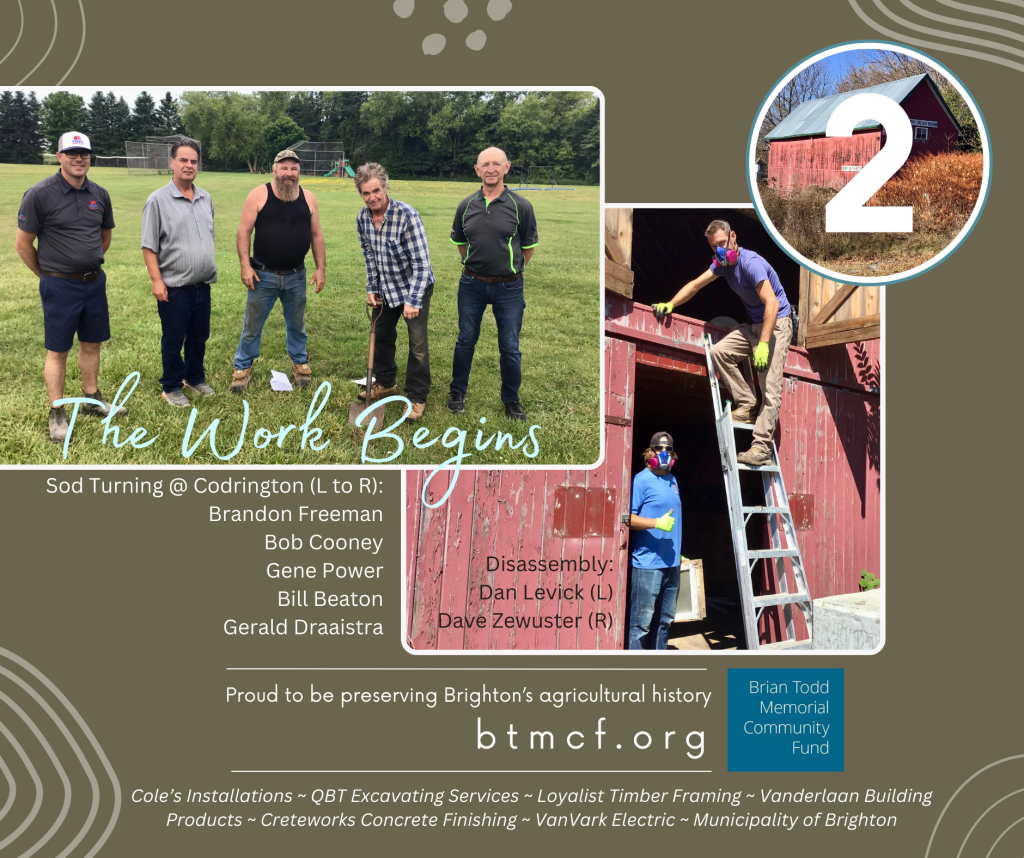
Following months of planning between the Brian Todd Memorial Community Fund and the Municipality of Brighton, a new site was selected (immediately south of the Codrington Community Centre) and a building permit was issued on June 20th.
Work at both locations recently began! While Dan Levick and Dave Zewuster of Cole’s Installations were cleaning out the barn at its current site (former Memory Junction property just west of Northumberland Fine Food), an unofficial sod turning was performed at the new site in preparation for the pouring of a concrete slab. Pictured are Brandon Freeman from Cole’s Installations, Bob Cooney QBT Excavating Services, Gene Power and Bill Beaton Loyalist Timber Framing and Gerald Draaistra, Vanderlaan Building Products Ltd. The support of their businesses, as well as from Creteworks Concrete Finishing LTD, VanVark Electric, engineer Tim Krahn and architect Reno Piccini will be chronicled in future posts as the work progresses. We can’t begin to thank them enough for their enthusiasm and support for this project!
Recording the progress of this barn relocation is just the most recent part of a longer story. The history of how we got to this point is a story worth telling. Initial posts in this series will focus on the barn’s origins, on the people who built it, and on its importance in a very busy hops growing industry in 19th century Brighton. It will list the names of more than 50 local hops growers and pickers, many names still recognizable today but many that are not. Perhaps readers will be reminded of their ancestral roots and can share some stories to fill in some historical gaps in Brighton’s agricultural past.
We hope you enjoy this historical journey!
📸 Bruce Davis
3️⃣ WHAT ARE HOPS?
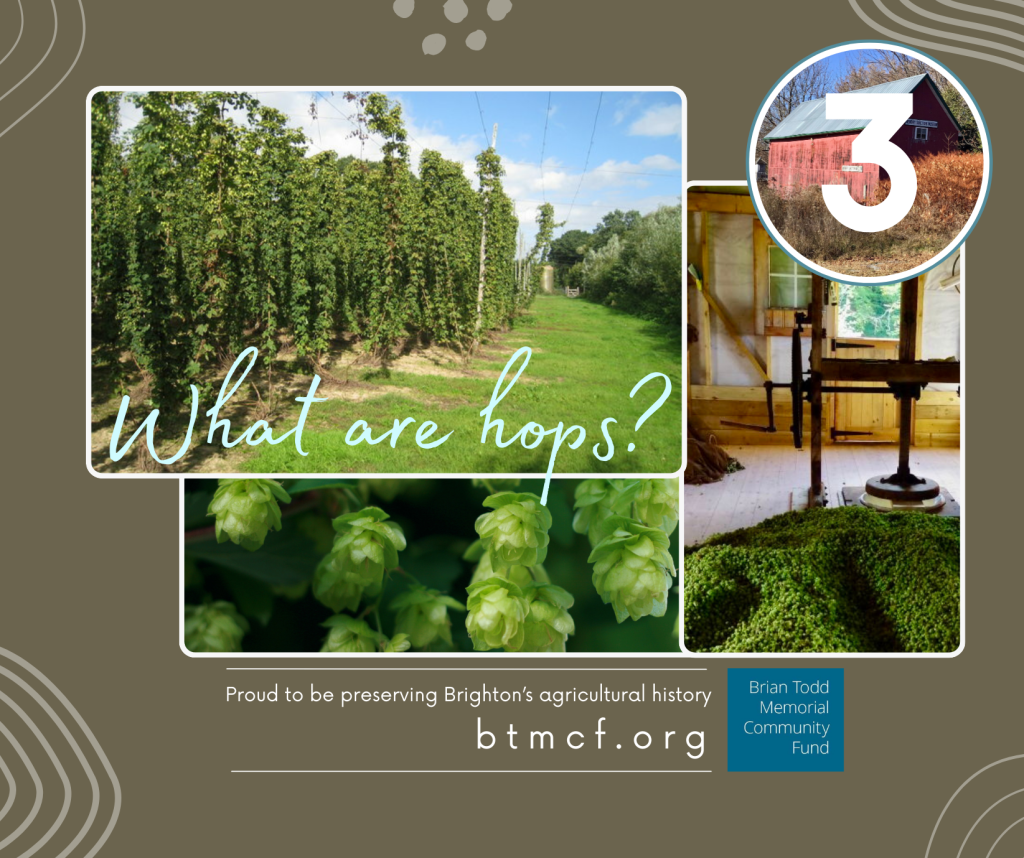

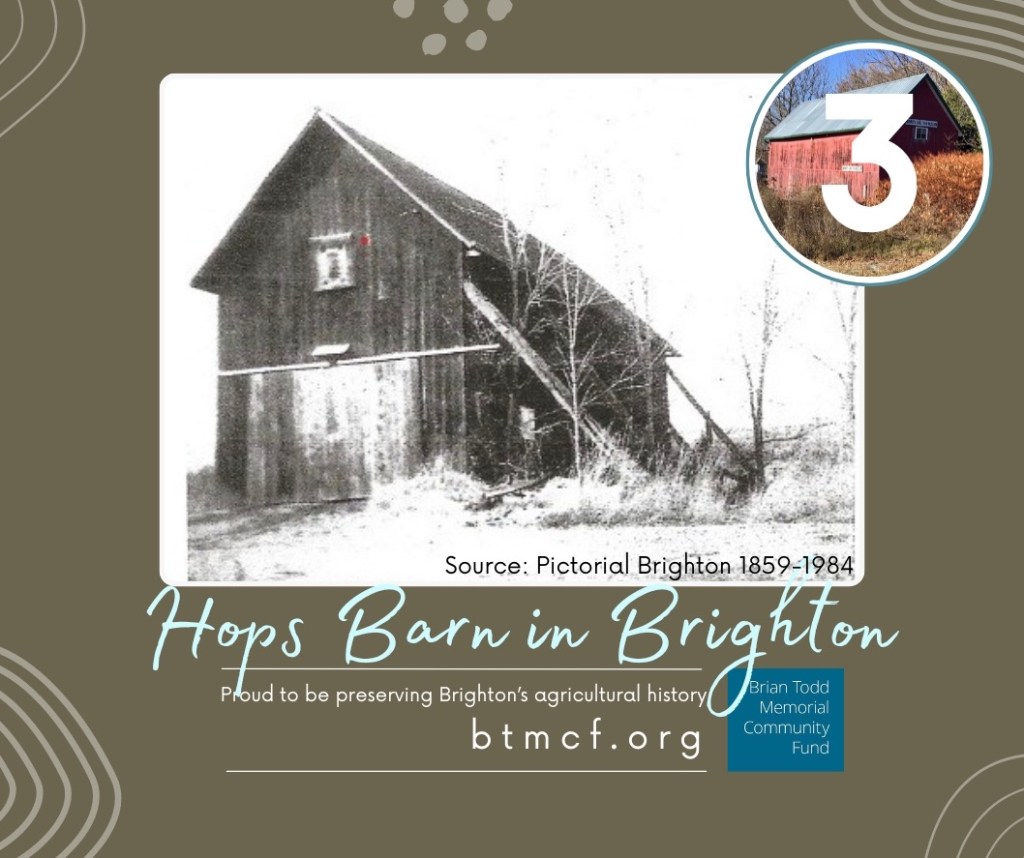
Hops are the seed cones of the hops plant. They are used primarily as a bittering, flavouring and stability agent in beer. It is best grown in well drained sandy loam soil in moderate climate. These soil conditions exist in the Brighton area. In the mid-1800’s, most local farmers grew hops.
The hops plant is a vigorous climbing perennial, and it was “trained” to grow on strings attached to wooden poles, reaching heights of ten feet or more. It would be picked by hand, generally in the month of August, when the seed cones were ripe, (strong scent, hardness to the touch, and brownish in colour). The seed cones needed to be picked and sent to a hops kiln for drying as soon as possible after picking, and required many labourers over a very short period of time.
When the seed cones arrived at the hops kiln, they would be spread out on cheesecloth about one foot in depth on a floor directly above the kiln. The most common fuel used was charcoal. Drying time was about eight hours, after which they would be stored for a couple of weeks before being pressed and bagged. Once bagged, they were shipped to Upstate New York – Rochester’s Genesee Beer Company was the predominant destination – often by rail from the Grand Trunk Railroad Station in Brighton.
Pictured is the depiction of a typical hops kiln design. They varied in shapes and sizes, but all performed identical functions – drying, pressing and bagging. The barn being re-located to Codrington would have had all of these features in the 1890’s – an upper drying floor, a kiln below and an area for pressing and bagging. Unfortunately, when this barn ceased being used for hops drying on or about 1915, the kiln and press were removed, and the upper drying floor was removed as well. When the barn was moved to Memory Junction in 2002, an upper floor was added but, given strict building code restrictions in place for public assembly use, it cannot be included in the re-assembled structure.
📸 hops field ~ geograph.org.uk
📸 hops ~ Paul Miller, Flickr
📸 drying hops ~ abushelofhops.co.uk
📸 kiln design ~ historicengland.org.uk
4️⃣ BASIL MCMASTER ~ HOPS GROWER, BOOK WRITER, CHAMPION of the HOPS BARN
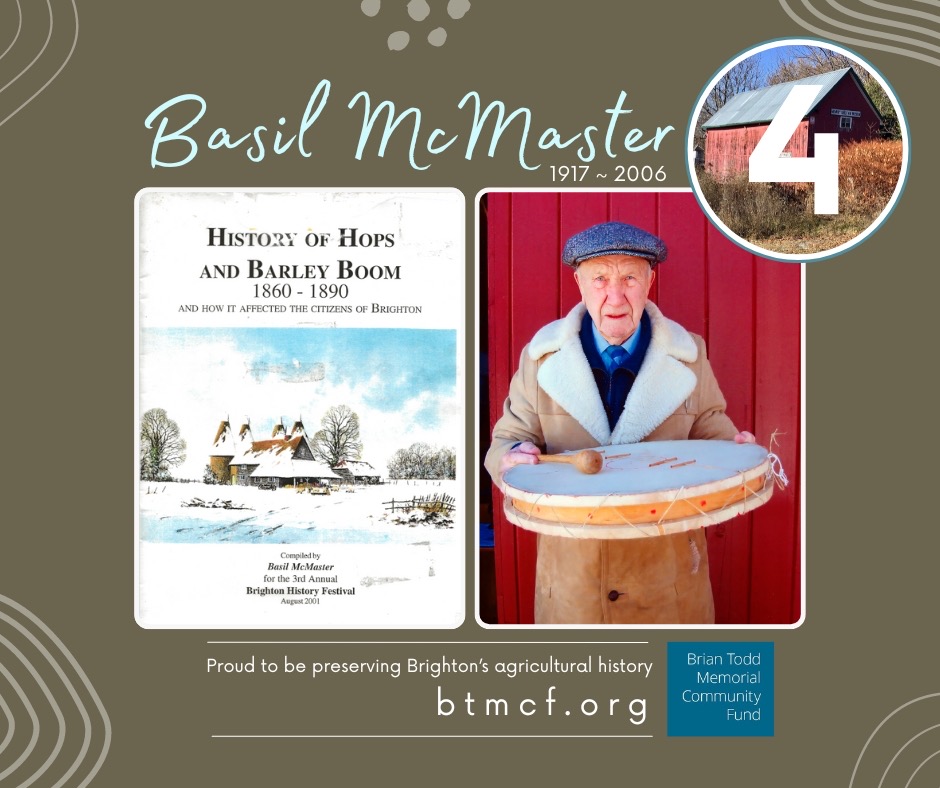
In 2001, at the age of 84, Basil McMaster wrote a book entitled ‘History of Hops and Barley Boom 1860-1890 and How it Affected the Citizens of Brighton’. Basil knew a lot about hops, given that his great-grandfather George, his grandfather Elijah, and his father Ernest were all hops growers in the Brighton area. Basil also grew hops in his earlier days.
His book describes how important hops was to Brighton and area farmers in the late 1800’s. He includes the names of more than 30 hops farmers (which will be listed in an upcoming post), as well as the names of hops pickers, most of whom were women and children. He describes how hops were grown and how beer was made; and he recounts how the local hops industry came to a grinding halt in the 1890’s when the United States imposed high tariffs on Canadian hops. According to another local historian, the late Peter McConnell, who is quoted in the book, “Hops and barley. Our first boom. After it went bust, only then did we begin to become ‘Apple Country’. By default.”
It was Basil McMaster’s grandfather Elijah who, along with the farm owner Willet Bedal, built a hops barn in 1880. According to Basil, this is the only remaining hops barn still in existence in the area. In 2002, with the help of many friends and volunteers, Basil moved the barn from its original home on Lot 27, Concession 2 (Telephone Road about two kilometres east of County Road 26) to Memory Junction Museum in Brighton.
 THANK YOU, Basil, for taking that first critical step in saving an important part of Brighton’s 19th century history. But, as you will see, this was not the last journey that this barn would take…!
📸 Brighton Digital Archives
5️⃣ DO ANY OF THESE NAMES SOUND FAMILIAR?
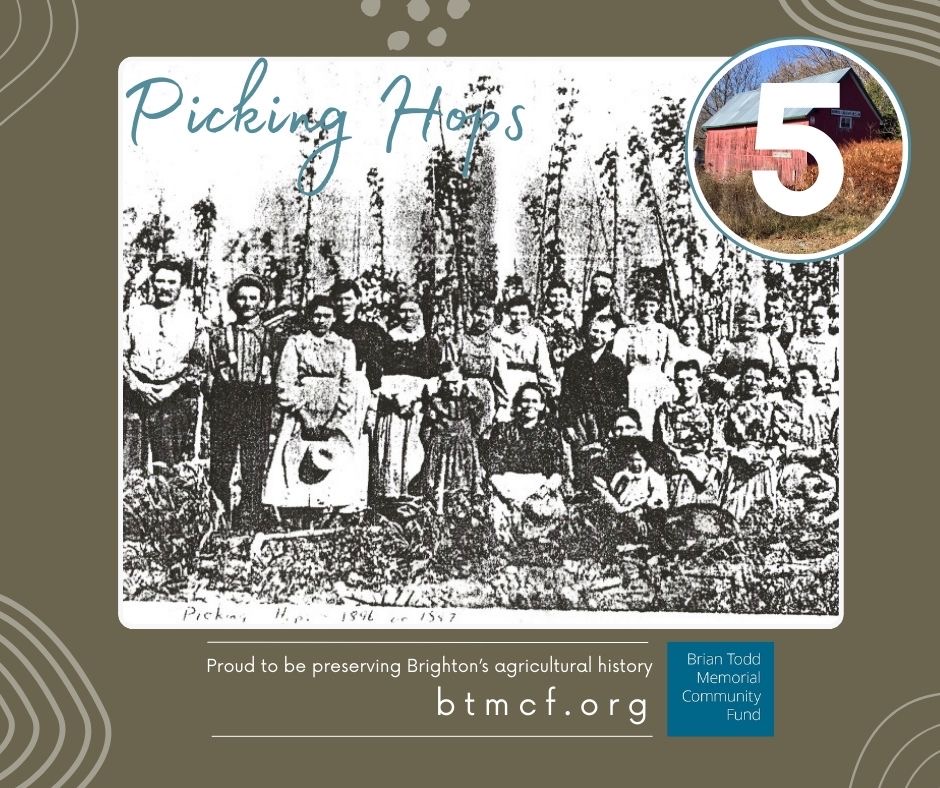
Picking hops seems like it was labour-intensive and a family affair. Basil McMaster’s book includes a photo that shows a group of over 20 pickers, the majority of whom are women along with several children. The photo is thought to have been taken on the farm of Aaron Coulter on the old Smithfield Road. The names of the people in the photograph are included and are listed below.
 Do you know the descendants of any of these people? Are you a descendent? We would like to know … please
  join the conversation and share your connections with us!
Paul Twiddy (village blacksmith – Smithfield)
Porter Coulter
Ethel Freeman (half sister of Mrs. Fred Snelgrove)
Martha Gwen Needle (first wife of Tom Needle )
Mrs. Peter Peister (Sarah Jones)
Jennie Gertrude Peister (married Harry Fritz)
Nellie Post (adopted daughter of Mr. and Mrs. Rinard Post)
Effie Sprentall
Mrs. Jacob Peister (Mary Ann May)
Aggie Clouston
Master Fred Oliver
George Wesley Peister
Heber Coulter
Kenneth Maitland (~ 3 years old)
Mary Hardcastle
Miss Bertha Coulter (became Mrs. Oliver)
Mrs. Clouston
Mrs Rinard Post
Maggie Matson
Aaron Coulter
Mrs. George Peister (Elizabeth Hardcastle)
Kate Coulter (daughter of Henry Coulter)
Unard Post
Mrs. Ed Coulter
Grace Needle Hamilton (daughter of William Needle)
Mrs. Fred Snelgrove (Jennie Freeman)
Laura Snelgrove
📸 History of Hops and Barley Boom 1860-1890 and How it Affected the Citizens of Brighton, compiled by Basil McMaster
6️⃣ 19th CENTURY BRIGHTON HOPS GROWERS & KILN OWNERS

By 1878, more than 30 local farmers were growing hops. Basil’s book identifies local farmers who grew hops and those farmers who also owned kilns.
If you can share any information about these 19th century farmers, we’d love to hear from you!
📸 hops emoji – creativecommons.org
7️⃣ RALPH BANGAY ~ THE SECOND OWNER OF THE BARN

Paraphrasing an article by John Campbell (Brighton Independent) that appeared in Northumberland News following his passing in July 2019 … “Ralph Bangay had a love of local history. He had an astute eye for memorabilia, including artifacts, photos, deeds and documents. He loved the Brighton community, spending a lifetime collecting “stuff” to preserve its history. Throughout his lifetime, he collected treasures found in the attics and basements of his plumbing and heating customers, always happy to take them off their hands.
But what was he to do with all of this ‘stuff’? According to his daughter Lynne, “his dream was to have a museum for all of the stuff he collected”. That dream came true when he had the opportunity to purchase the former Grand Trunk Railway station and surrounding property in the mid-1990’s. He saw that station as “something to be saved of our heritage”, said Lynne.”
So it is little wonder that, in 2002, when Basil McMaster asked Ralph Bangay to give the hops barn a second home at Memory Junction, he was only too happy to accept the offer – a place for more of his ‘stuff’! Once in place on the Memory Junction property, Ralph used the barn to display railroad artifacts and agricultural exhibits, including one that featured the activities of hops farming in the 1800’s.
Ralph, along with his wife Eugenia, operated the museum until 2017 when poor health caused the museum to be closed.
Following Ralph’s passing in 2019, the museum was de-commissioned and individual items sold off. The hops barn, however, remained on site when the property was purchased by Cole’s Timber Mart a few years later.
Thanks to Ralph Bangay and Basil McMaster, this barn escaped demolition in 2002. For the next 15 years, Ralph made sure it did not fall into disrepair. Through his actions, he made it possible for a third chapter to be written in the story of this 144 year old barn.
Ralph Bangay was a pretty good artist too. Included is one of his drawings that is especially relevant to this project – it shows Basil McMaster and the hops barn that he and Ralph saved.
THANK YOU, Ralph!
📸 Ralph Bangay at the Memory Junction Railway Museum – File photo Sarah Hyatt/Metroland
✍️ Cartoon & Ralph and Eugenia Bangay – family archives
8️⃣ INTERESTING BARN TREASURES
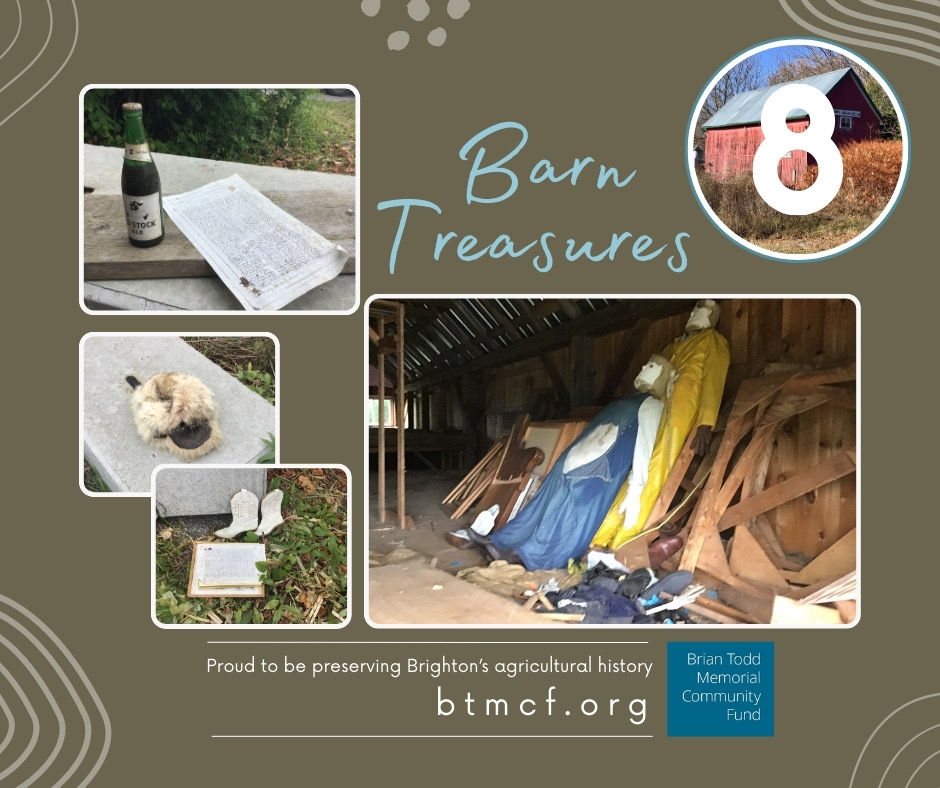
Dave and Dan of Cole’s Timber Mart Installations began cleaning out the barn on June 26th. The bottom floor was relatively empty, but the upper loft was full of surprises … A fur hat (initially mistaken for an animal!), an unopened bottle of O’Keefe Old Stock Ale (not like wine and cheese – it doesn’t get better with age!), a pair of boots, two very distressed mannequins (remains of Memory Junction Railway Museum exhibits), and several vintage documents, one of which was a handwritten list (circa 1925) of names. Some of the surnames listed are still prevalent in Brighton today: Chatten, Pound, Quick, Tackaberry, Herrington and Cheer. Basil McMaster’s name is also on the list. He would have been eight years old in 1925. This list will be turned over to Brighton Digital Archives for archiving and further research.
📸 Bruce Davis
9️⃣ BASIL MCMASTER ~ AN EARLY SUPPORTER of the BRIGHTON HEALTH SERVICES CENTRE

Basil McMaster had a lot of things on his mind in 2002. After all, he was heading up the relocation of the hops barn from Telephone Road to Memory Junction. He was undoubtedly absorbed in this project – no small task for a man of 85 years of age!
Basil was also aware of another ambitious project that had its beginnings in the fall of 2001. A group of Brighton citizens had set out to create a medical facility in Brighton, one that would serve as a home for several family physicians that were needed to provide primary health care services to Brighton residents. That project was referred to as the ‘Brighton Health Services Centre’. Considerable funds were needed to be raised to support the purchase and renovations of the former Creekside Banquet Hall. What was needed in those early days of the fundraising campaign was the support of high profile ‘leadership donors’ to spread awareness for this ambitious project. Enter Basil McMaster.
Basil announced a donation of $10,000 at the fundraising kickoff event held at the newly-purchased, pre-renovated Creekside Banquet Hall in 2002. Included is an image of Basil speaking at that event. In that same photo is the late Brian Todd, founding Board Chair of the Brighton Health Services Centre, and former BHSC Directors Wolfgang Richter and Dorothy Fletcher, wife of the late Dennis “Fletch” Fletcher, the man who crusaded to have the barn moved to Codrington.
Basil supported our project in 2002. He would no doubt be pleased to see that, 22 years later, the favour is being returned.
📸 unknown; courtesy of Dorothy Fletcher
🔟 “LET’S MOVE IT AGAIN!” ~ DENNIS FLETCHER

Dennis Fletcher (Fletch) was fascinated with barns. He was so fascinated with them that he led a project in 2017 to capture images of all of the barns in the Brighton area. Several of the barns were featured in Brighton Digital Archive’s 2018 and 2019 souvenir calendars.
Fletch was also fascinated with local history. He was an active organizer of annual History Week events, often times dressing in period attire. A founding member of Brighton Digital Archives, the growing collection of BDA’s historical photos and documents are in no small part a result of his efforts.
With these two ‘fascinations’, it was little wonder that when Memory Junction Railway Museum closed in 2017, Fletch set about to ensure that the hops barn would be saved. He believed that the barn could be re-located to Codrington, where it could be re-purposed into a public space, where it could be utilized for expanded farmers’ market and artisanal activities, historical and other events. Fletch sought, and received the support of several community groups, and was in the process of securing the funds necessary to re-locate the barn when, in March 2020, COVID put a halt to his initiative. His health deteriorated during the prolonged pandemic, to the point where he was unable to resurrect the project. Following his passing in September 2023, the Brian Todd Memorial Community Fund picked up Fletch’s baton and is currently completing his dream.
The Brighton community will be forever grateful to Fletch on so many levels ~ THANK YOU Fletch!
📸 Brighton Digital Archives; courtesy of Ralph DeJonge
1️⃣1️⃣ COMMEMORATIVE PLAQUES TELL THE STORY

When Basil McMaster successfully re-located the barn to Memory Junction Railway Museum in 2002, he had two metal plaques created to commemorate the event. These plaques were affixed to the outside of the sliding doors as permanent reminders of his grandfather’s and Willet Bedal’s role in building this hops barn in 1880.
At some point after 2002, these plaques received an unwelcome paint job from parties unknown. We are grateful to Joe Firlotte of Uncle Joe’s Attic in Brighton, who recently restored these plaques to vivid clarity. They will be affixed to the barn once again as a final step in its re-location to Codrington. There are plans to add a third plaque to tell the story of the barn from 2002 to 2017 (when it was used as an exhibit space at Memory Junction Railway Museum) and to outline the current steps in re-locating it to its new home.
📸 Bruce Davis
Moving the Hops Barn from Brighton to Codrington
ALL THE KING’S HORSES AND ALL THE KING’S MEN
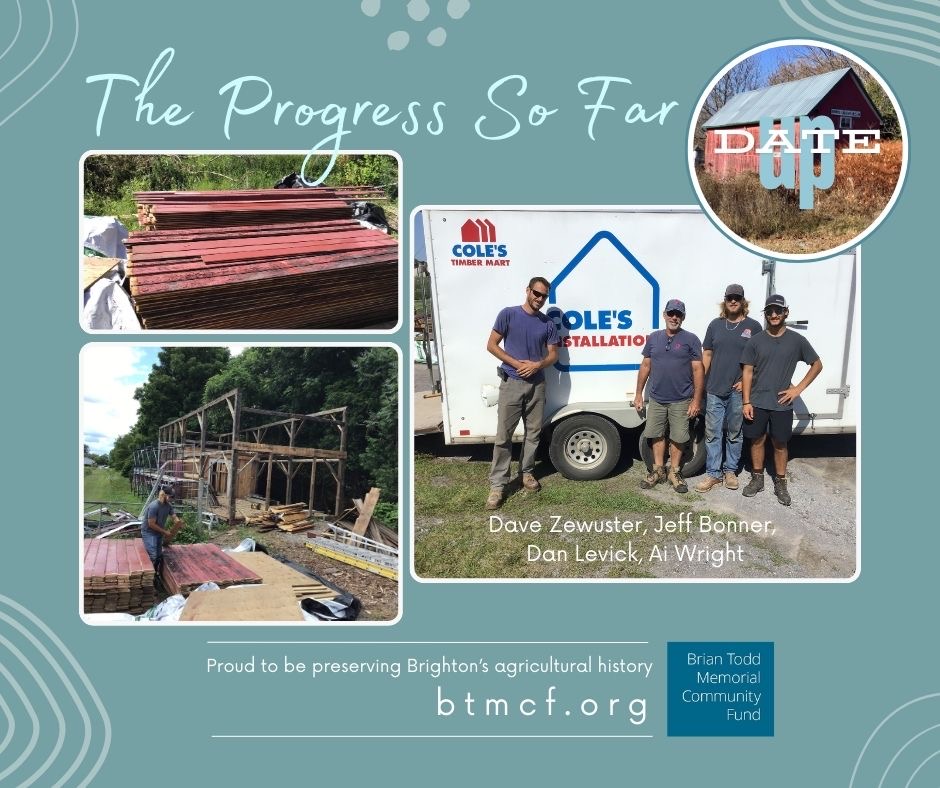
When Humpty Dumpty fell off the wall, he broke into many pieces. He couldn’t be put back together again for one simple reason – his many pieces had not been marked. Well, that is not going to happen with the hops barn! All of the barn’s boards – over 600 of them – have been individually marked as they were removed. All of the 144-year-old roof trusses have been similarly marked. When the barn is re-assembled in Codrington, they will be returned to their original position. Too bad Humpty Dumpty was not as fortunate!
The external coverings have now been removed, thanks to the incredible work of Cole’s Installation’s Dave Zewuster, Jeff Bonner, Dan Levick and Ai Wright.
With the skeletal posts and beams now fully exposed, the next step will handled by Loyalist Timber Framing’s Bill Beaton and Gene Power, specialists in the restoration of old barns. Bill Beaton supervised the original relocation of this barn in 2002, as
well as the construction of the Proctor-Simpson Barn Theatre in 2001.
With the barn’s disassembly at Memory Junction almost complete, attention will shift to Codrington very soon!
📸 Bruce Davis
PROGRESS! THE JOURNEY CONTINUES
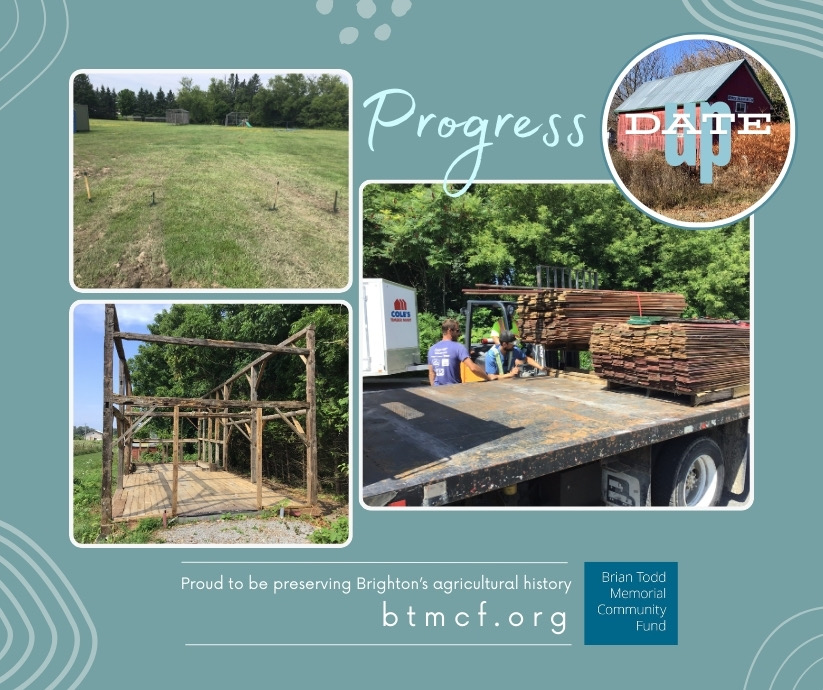
The barn is almost completely dismantled at its current site (former Memory Junction Railway Museum). What will happen next?
 QBT Excavating Services will prepare the site in Codrington
 Creteworks Concrete Finishing will pour a concrete slab
 Bill Beaton and Gene Power of Loyalist Timber Framing will dismantle the posts and beams at the current site and re-assemble them, along with the original roof trusses, in Codrington
 Vanderlaan Installations and Cole’s Installations will re-assemble the walls and steel roof
 VanVark Electric will install electrical outlets and lighting
 a new paint job will complete the project!
BREAKING GROUND
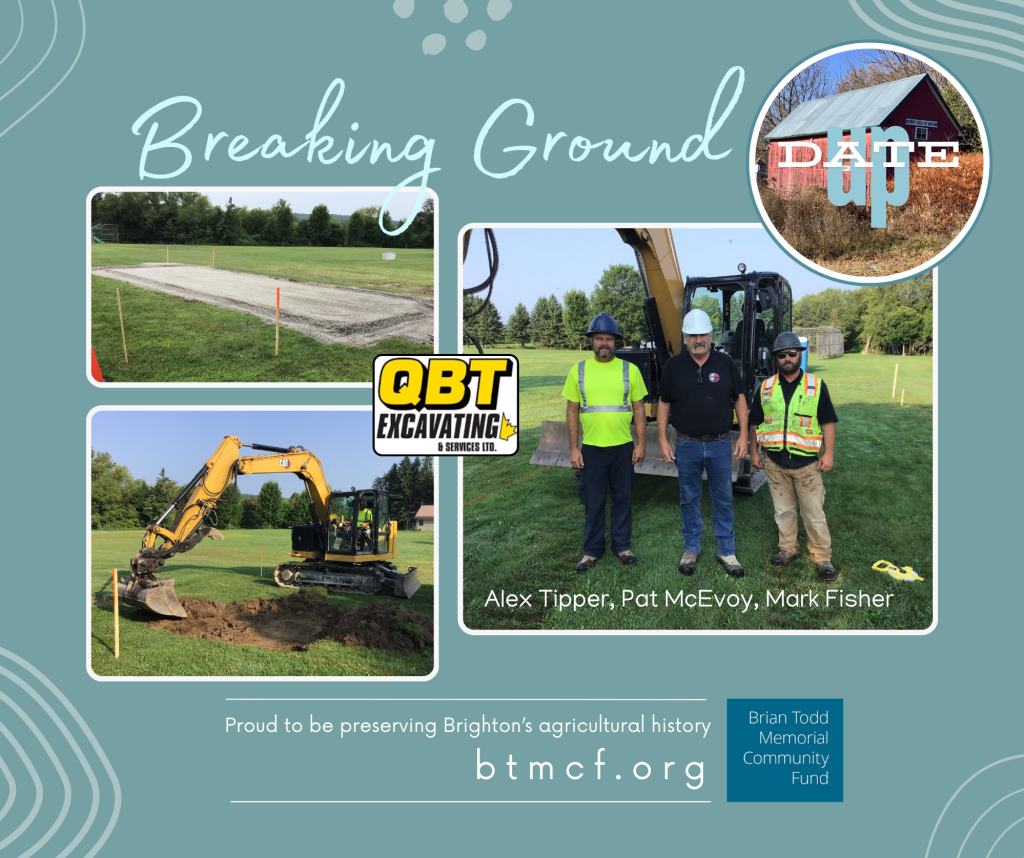
It was a hot and muggy day last Thursday, but that didn’t stop QBT Excavating Services from preparing the site of what will be the NEW home of the hops barn.
Under the guidance of Pat McEvoy, QBT’s General Site Superintendent, Alex Tipper and Mark Fisher removed the top covering from the site in readiness for the delivery of granular base material, which was then levelled and compacted.
Our heartfelt thanks  goes out to Bob Cooney and to his successor company QBT Excavating Services Ltd.
ON SOLID FOOTING
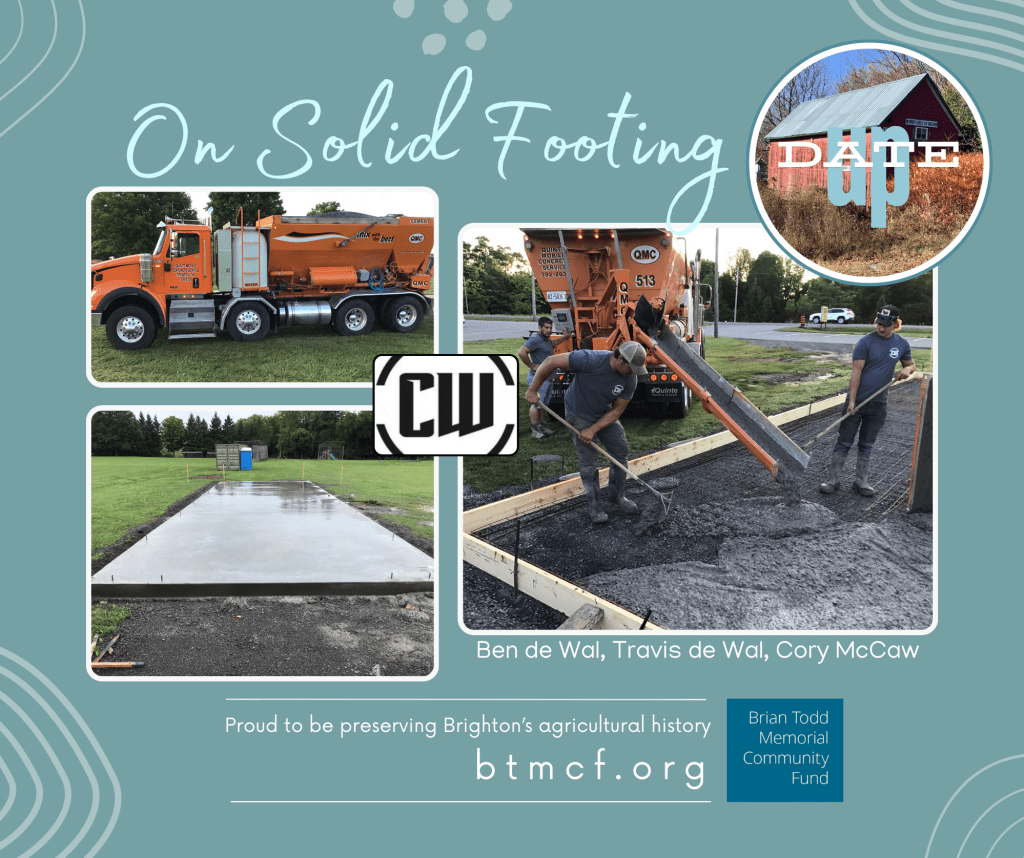
When the hops barn was built in 1880, it had a combination earth and wooden floor. When the barn is fully re-assembled in Codrington, it will have a concrete floor, including sloped, non-slip barrier-free entrances (2), thus expanding opportunities for public use.
Shortly after dawn last Thursday, a cement truck driven by Ben de Wal of Quinte Mobile Concrete Services rolled into the Codrington site. Travis de Wal and Cory McCaw of Crete Works Concrete Finishing were there to spread and smooth out the concrete over the pre-formed surface.
Kudos to early risers Travis, Cory and Ben!
The next step will perhaps be the most exciting of all. We will put ‘Humpty Dumpty’ back together again!
ON THE MOVE!
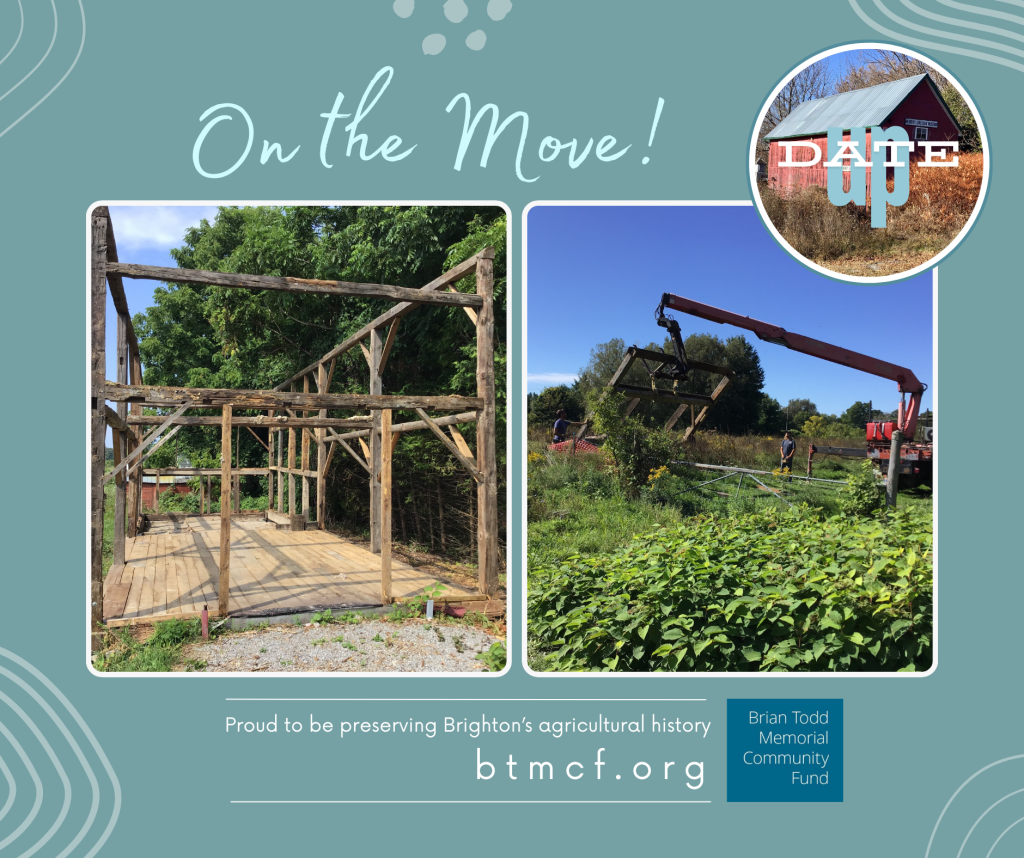
The final parts of the barn were recently dismantled at the former site of the Memory Junction Museum. Using a boom truck generously provided by Cole’s Timber Mart, the side and end walls were gently lowered to the ground and taken apart, but not before each post and beam was marked to assure that the walls would be identically re-assembled at the Codrington site.
Finally, Memory Junction has bid adieu to the hops barn.
Justin of Vanderlaan Building Products transported the disassembled components to Codrington late last week. Bill Beaton and Gene Power of Loyalist Timber Framing will begin the task of putting it back together again.
Tomorrow’s post will describe the method of timber framing used in the re-assembly process. That is the same process that was used by Willet Bedal and Elijah McMaster in 1880 when the barn was first constructed.
PUTTING IT BACK TOGETHER AGAIN!
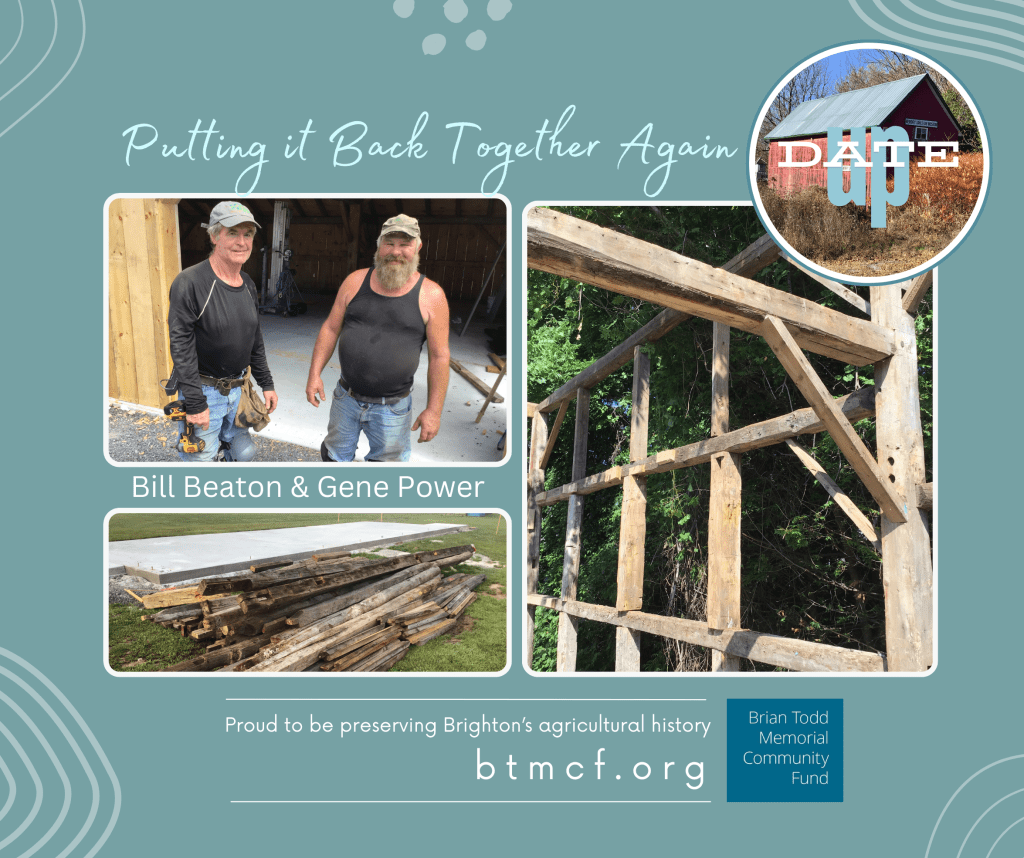
Putting the barn back together begins with the most important part of the barn – its ‘bones’. It will be re-assembled the same way as it was originally built in 1880. The 144 year old wooden posts, beams, joists, lintels, rafters and trusses will be connected using the historical method of ‘timber framing’. In the 1800’s and earlier, barns were constructed with large timbers that were milled and cut to form the main load-bearing structure of the barn. Think of timber framing as a big thick skeleton from which the roofing and wall sheathing is adhered. Mortise and tenon joints were carved into the wood so that they fit together, eliminating the need for fasteners. Connections were made with wooden pegs known as trunnels – metal fasteners were not used in the original timber framing method.
The barn frame has been reduced to a puzzle pile of posts and beams, but every one of them has been marked. Putting this puzzle back together requires a unique skill.
We are fortunate to have experienced timber framers Bill Beaton and Gene Power to replicate this technique on this hops barn.Together, they have restored several structures in Prince Edward County and the surrounding area. Bill was involved in the first relocation of the barn from Smithfield to Memory Junction. He also headed up the project that saw the Simpson barn relocated from a farm west of Brighton to Proctor Park, where he led its conversion into what is now the popular Proctor-Simpson Barn Theatre.
Thanks to Bill and Gene for retaining that authentic historical feature of this barn!
TAKING SHAPE!
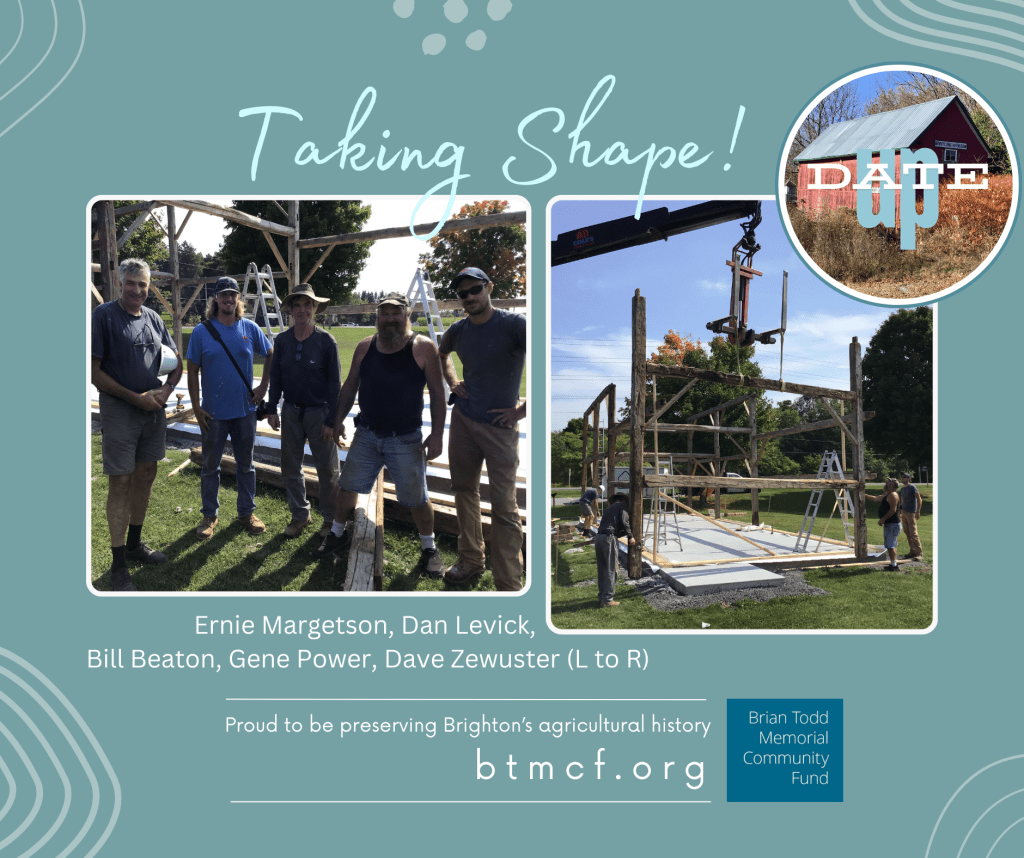
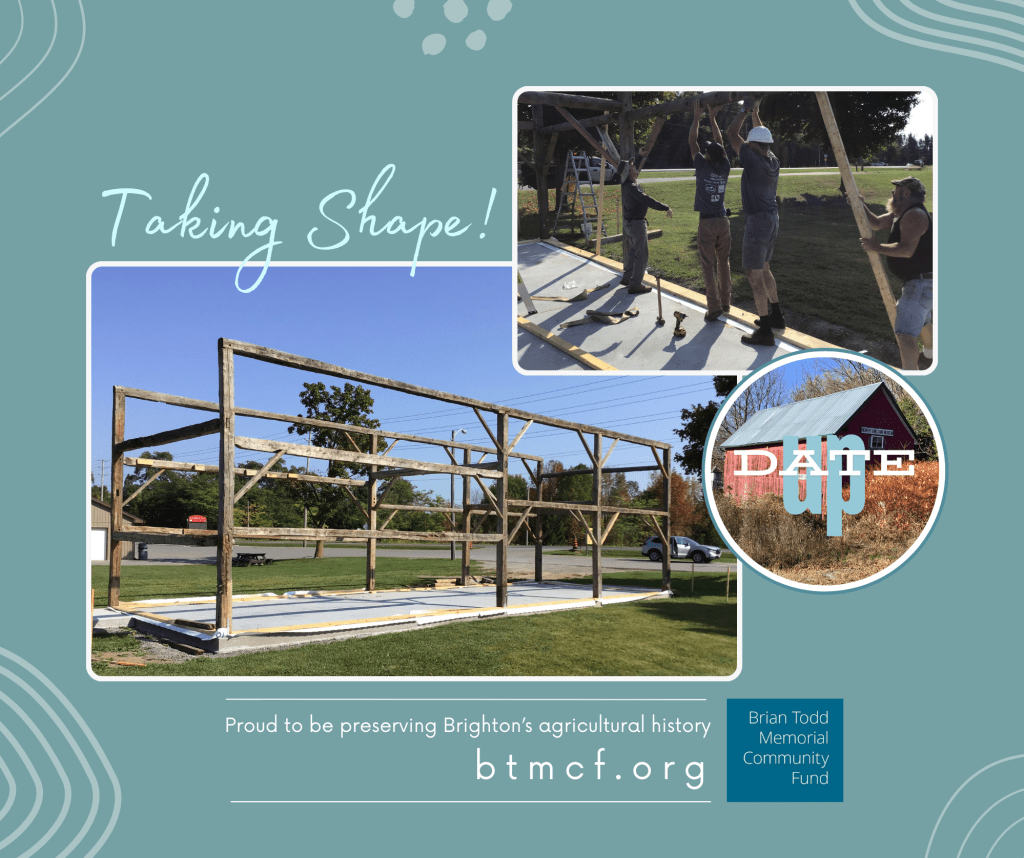
It was a beehive of activity on Tuesday, September 17th, as the skeleton of the hops barn was re-assembled. With the sections (bents) having been put together the day before, the lower sections were guided into place by the four strong bodies of Bill Beaton, Gene Power, retired engineer Ernie Margetson and Cole’s Installations Dave Zewuster.
The higher portions required the use of Cole’s Timber Mart‘s boom truck, piloted by the steady hand of Cole’s Dan Levick. It was amazing to see how all of the posts and beams fit together perfectly, using the original mortise and tenon joints, and fastened together with wooden pegs (trunnels) into holes that were drilled 144 years ago. One can only wonder at how labour intensive this process had to be in 1880. Thankfully, we had a boom truck to make the task so much easier!
With the frame now firmly in place, the next step will be the installation of the fifteen original roof trusses. Yes indeed … it’s beginning to take shape!
A CHANGING SKYLINE
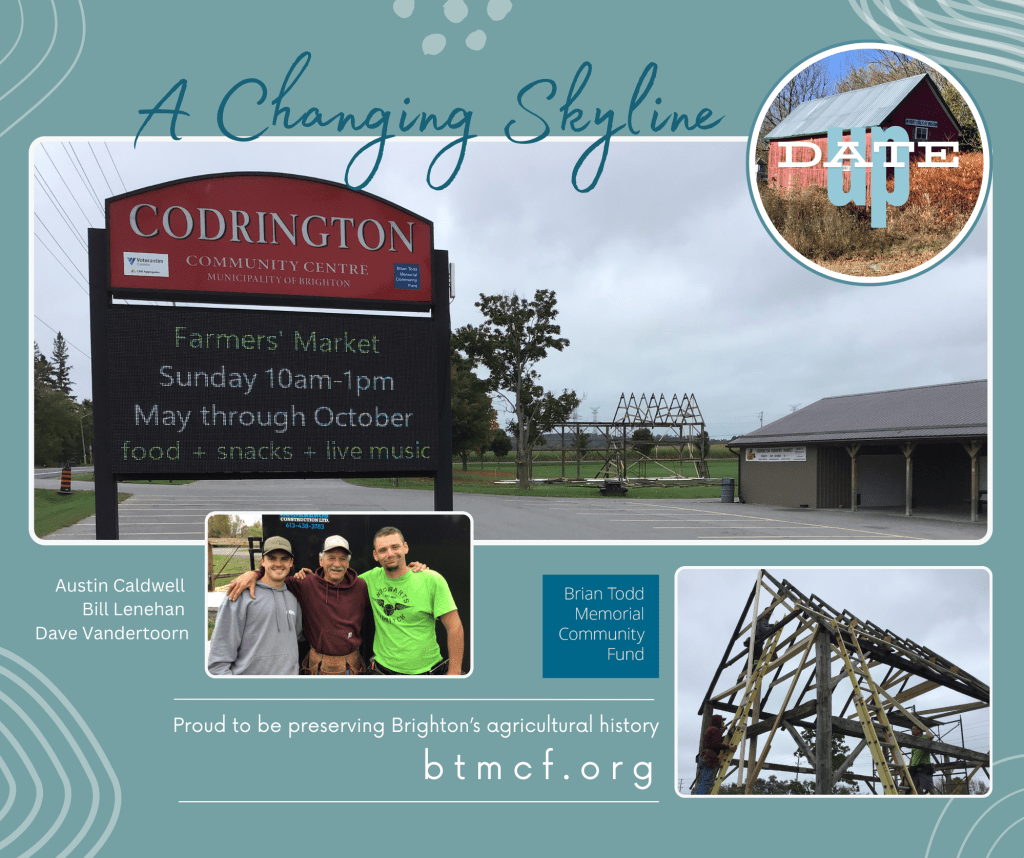
If you should happen to be out for a fall  drive through the historic community of Codrington, you will notice that the skyline is changing!
Viewed from the north-end of the Community Centre property, you will see that roof trusses are being installed atop the original hops barn frame.
Dave Vandertoorn of Vanderbros Construction, together with Austin Caldwell and Bill Lenehan are setting the 15 original trusses in place and are making it ready for the installation of a new steel roof.
ASSEMBLING THE PUZZLE
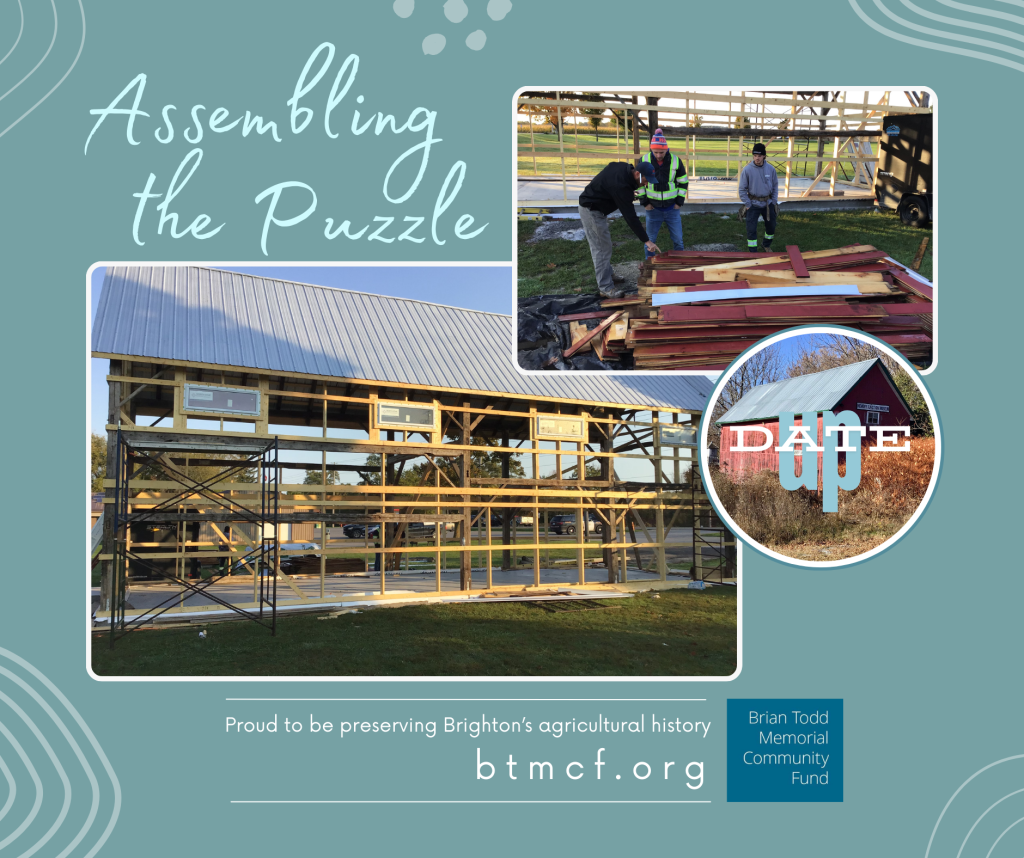
What a difference two short weeks make! The original trusses have been fully attached, the overall structure has been completely braced, windows and doorways have been framed, and a new steel roof has been installed.
Now it is time to re-attach more than 600 siding boards to the exterior walls. We are looking to ‘Puzzle-Master’ Dave Zewuster of Cole’s Timber Mart Installations to guide us through this process. It was Dave, with the help of Cole’s Dan Levick who painstakingly marked each board as it was removed earlier at Memory Junction, to ensure that each one of them was re-positioned in its original location.
In the accompanying picture, you can see Dave (left) revealing to Vanderbros Construction’s Dave Vandertoorn the solution to his puzzle, while Austin Caldwell looks on.
PUTTING UP WALLS (October 19, 2024)
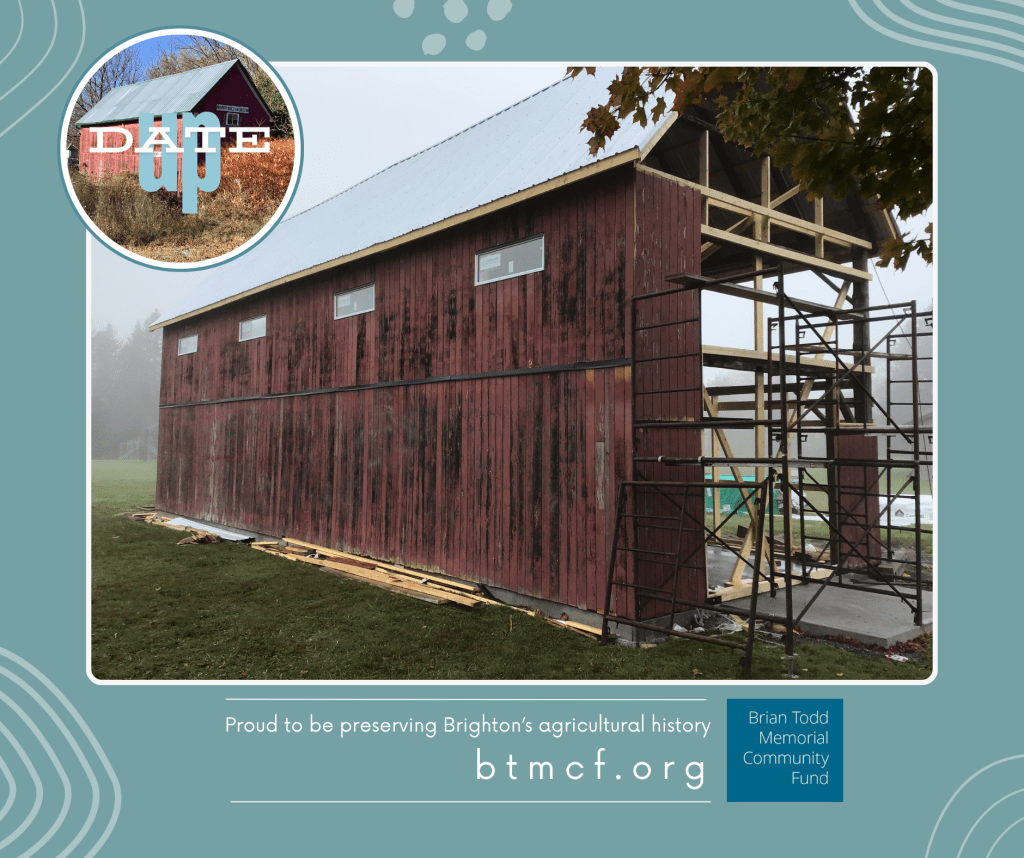
This photograph is taken from the south-facing wall. The east and west end walls are partially completed and the north wall remains to be sided and have four windows installed.
IN THE HOME STRETCH! (October 25, 2024)

This project that had its beginnings last September is finally nearing completion! The barn is almost completely sided – the south-facing and west-facing walls are done, and Vanderbros Construction’s Dave Vandertoorn and Harman Singh continue to work on the eastern wall at the time these pictures were taken. In a few days, the barn should be completely closed in. Only the electrification and a fresh coat of paint remains, both of which will be done over the Winter/early Spring.
It is hoped that, before the snow falls, there will be an opportunity to assemble at the barn site the many generous businesses and individuals who made this project happen to officially acknowledged their efforts.
WHEN TIM MET RENO (November 2, 2024)
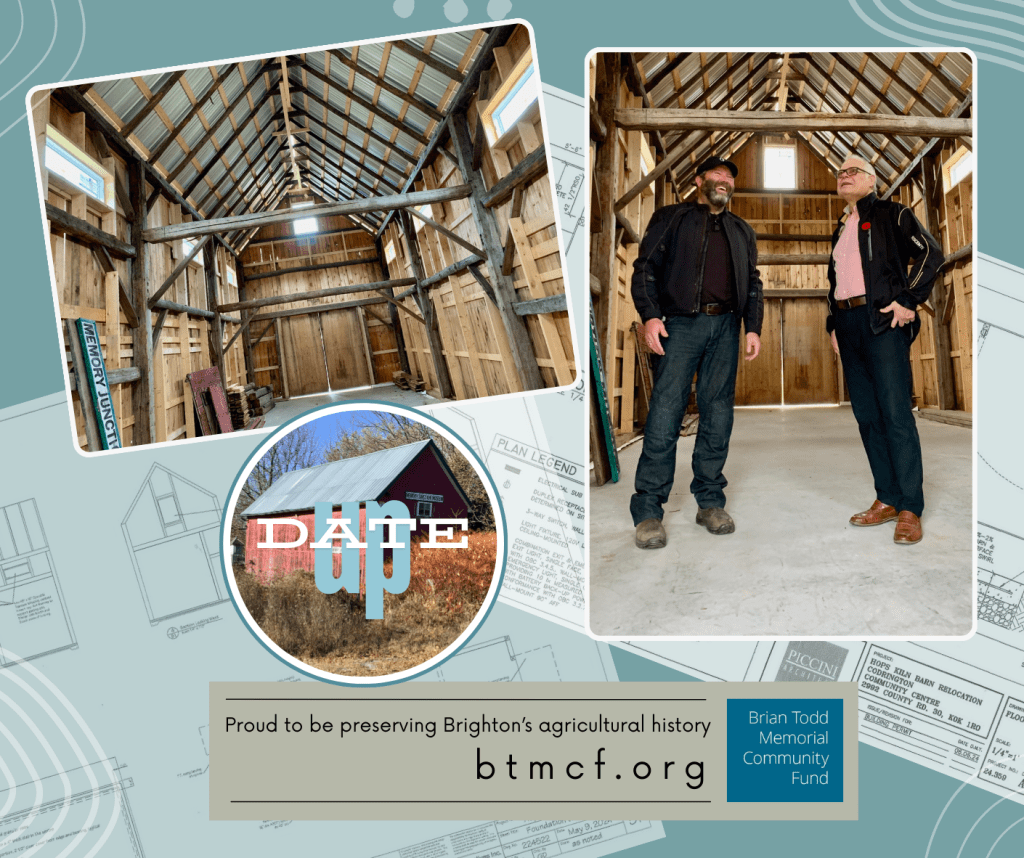
Recently, engineer Tim Krahn met architect Reno Piccini.
Working separately and remotely, they developed two-dimensional drawings that guided local builders in the re-assembly and re-purposing activities of the hops barn at its new site in Codrington.
Tim, a resident of Codrington, was approached by “Fletch” in 2019 and asked to review existing
drawings of the barn that had been prepared when the barn was re-located to Memory Junction in 2002. When the project was revived earlier this year, he used these initial drawings as a starting point to develop a newer set that incorporated features required to meet current day building standards.
Reno, while not initially engaged in this project, was not unknown to the Brian Todd Memorial
Community Fund. In 2012, back when the charity owned the Brighton Health Services Centre, he had been engaged to produce drawings required for a major renovation to the upstairs physician space. So, when it became apparent that the services of an architect would be required for the hops barn re-assembly, Reno was asked to join Tim in producing the required documents.
Their efforts produced significant changes to the design of the refurbished hops barn:
- Where the original barn had only two windows – one at each end – it now has four additional windows on each side, providing considerably more natural light inside the barn;
- The barn now has a poured concrete floor, replacing the former combined wood and dirt floor;
- A rear door has been added to provide two accessible points of entry and exit;
- Electrical lighting and wall outlets have been added;
- Venting in the soffits and gable ends will improve air circulation
When Tim and Reno met at the barn site recently, it was the first time that they had had an opportunity to meet face-to-face and to see their drawings lifted off the paper and into a structural reality.
Thank you Tim! Thank you Reno!
DENNIS ‘FLETCH’ FLETCHER

The late Dennis “Fletch” Fletcher loved old barns and the stories behind them. He led a project in 2017 that saw the images of many of Brighton’s barns displayed on popular souvenir calendars. It was his passion for old barns that no doubt led to his objective to preserve the last remaining hops barn in the area.
Fletch was, and always will remain the inspiration behind this barn project. He put the wheels in motion in 2019 to save the barn. Without his passion, we would not be celebrating the preservation of this significant part of Brighton’s agricultural history. When the Brian Todd Memorial Community Fund re- started his project in July of 2023, it used Fletch’s plans and drawings as a starting point. There is no doubt that, had Fletch remained healthy, he would have achieved his objective.
The Brian Todd Memorial Community Fund, together with the generous support of so many community builders, is proud to have finished what he began.
All of us involved in this project are sending a message to Fletch on angel’s wings that simply says:
“Thank you Fletch. We did it.”
THANK YOU LYNN VANDERHERBURG
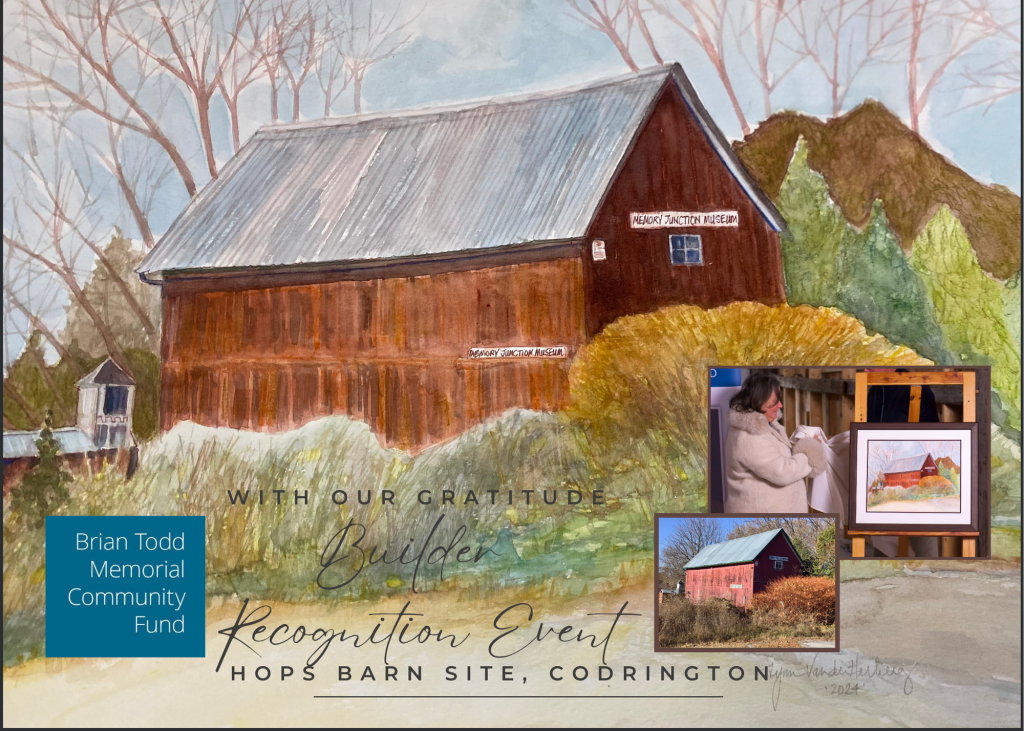
The historic hops barn no longer stands in its place at Memory Junction. Undoubtedly, there were many photographs of the barn taken over the last 22 years of its second life, the most recent being the one below. But we are not aware of any paintings of this barn done during that period of time.
Photographs can freeze an image, and there can be little debate as to the accuracy of the subject being photographed. But it rarely conveys the ‘life’ of the image. Only a painting can do that. So we turned to Lynn VanderHerberg, who has often been referred to as ‘Brighton’s artist laureate’, and we asked her if she could capture the ‘life’ of this barn on canvas. She readily agreed to do this.
Despite her very busy schedule of doing commissioned work for the new retirement home in Brighton and others, not to mention her soon-to-be-released cookbook (check it out at facebook.com/lynnvanderherberg), she unveiled her painting at the recent Builder Recognition Event. And, with her blessing, this creation was imprinted on plaques, presented to each of the businesses that helped re-locate this barn to Codrington.
Thanks so much Lynn! In your own special and talented way, you have preserved an important chapter in the history of this barn!
THE BANGAY FAMILY
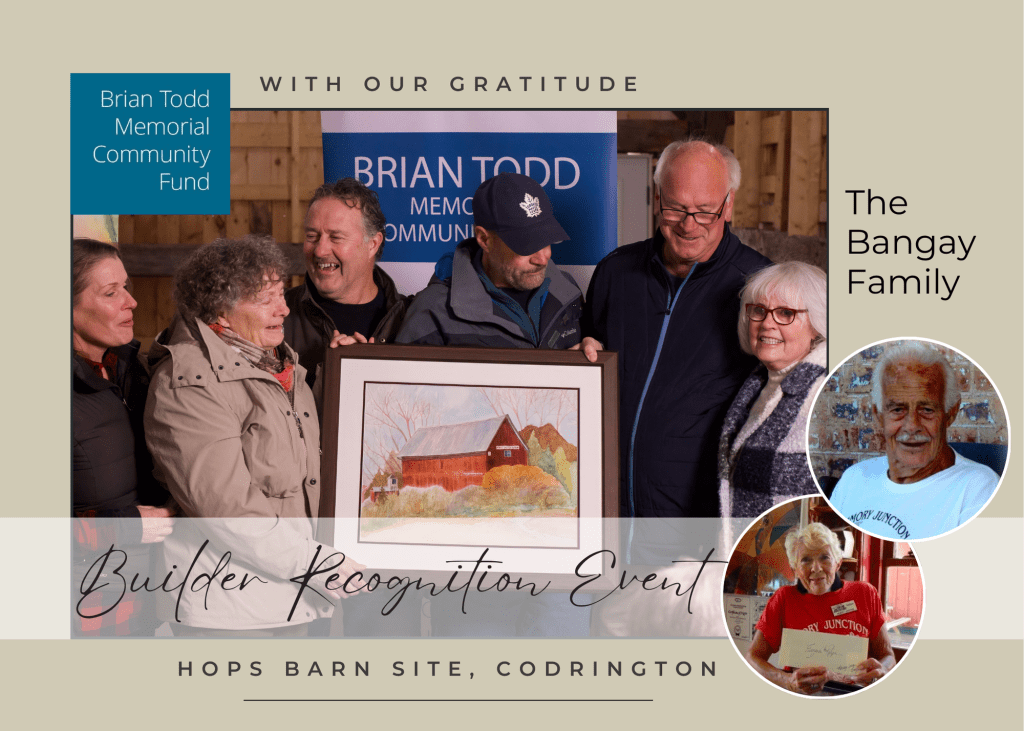
It is a well-known fact that, had Ralph Bangay not offered a spot on his Memory Junction property for this historic barn, it would have likely been demolished in 2002. He, along with his wife Eugenia, readily accepted the barn, and used it to display historical artifacts, many related to the history of the local hops industry.
At the Builder Recognition Event held last Friday, we were thrilled to welcome four of the Bangay children – daughters Lynne (Heeney), Gwen (Johnston), sons Brian and Rob. To their surprise, the original painting of the barn created by Lynn VanderHerberg was presented to them as a lasting keepsake. We could not think of a better home for this one-of-a-kind work of art.
In the photograph, Bruce Davis, BTMCF Director, presents Lynn VanderHerberg’s original painting to the Bangay siblings (L to R): sister-in-law Wendy, sister Gwen, brothers Rob and Brian, and sister Lynne
BUILDER RECOGNITION EVENT (November 22, 2024)
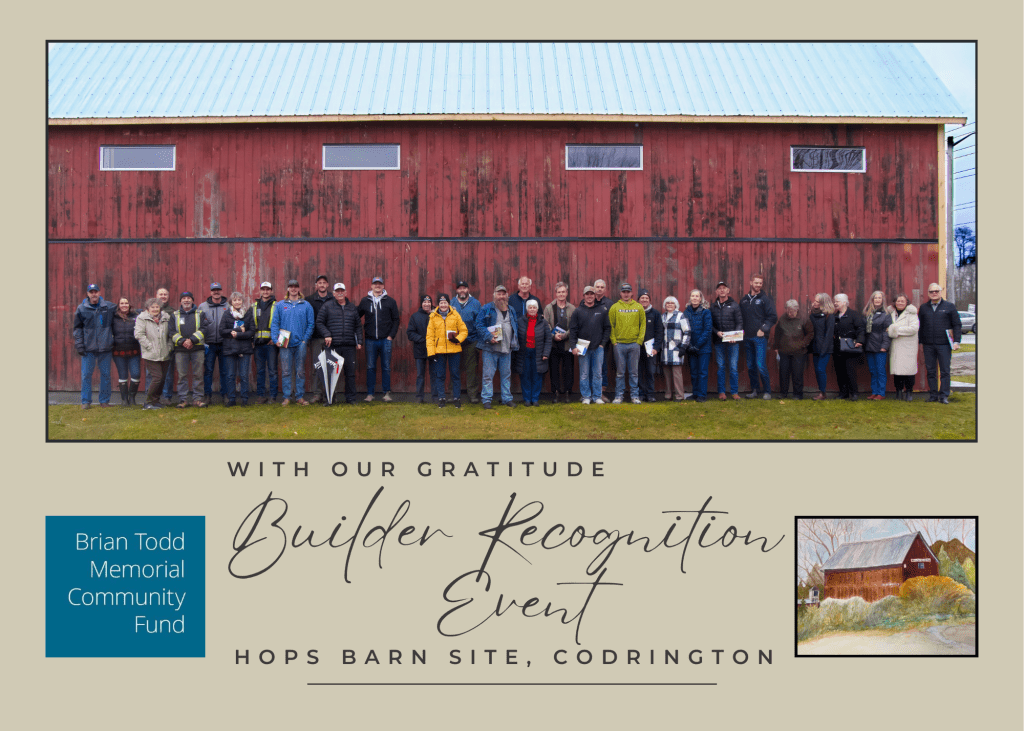
It was a chilly and windy day on Friday November 22, 2024.
But that didn’t stop over 40 people from attending a Builder Recognition Event at the new site of the restored hops barn in Codrington. The Board of Directors of the Brian Todd Memorial Community Fund presented commemorative plaques to 16 individuals and businesses that were so generous in their support of the project.
Special tributes to Memory Junction Museum owner Ralph Bangay and the late Dennis “Fletch” Fletcher were also made, and will be the subject of a future post.
Our heartfelt thanks goes out to the following ‘builders’ to whom, without their support, this project would never have gotten off the ground:
Cole’s Installations
Cole’s Timber Mart
Crete Works Concrete Finishing
Tim Krahn, P. Eng.
Loyalist Timber Framing
Municipality of Brighton
Reno Piccini, Architect
QBT Excavating Services
Quinte Mobile Concrete Service
Uncle Joe’s Attic
Vanderbros. Construction
Vanderlaan Building Products
Vanderlaan Installations
Van Vark Electric
With only a few additional touch-ups to be made, and an exterior paint job to be done in early 2025, the project is just about complete. An official opening will occur next spring.
A community is lessened when its history is forgotten. Thanks to these businesses, a significant piece of Brighton’s agricultural history has been preserved and will not be forgotten. 👏 🙏
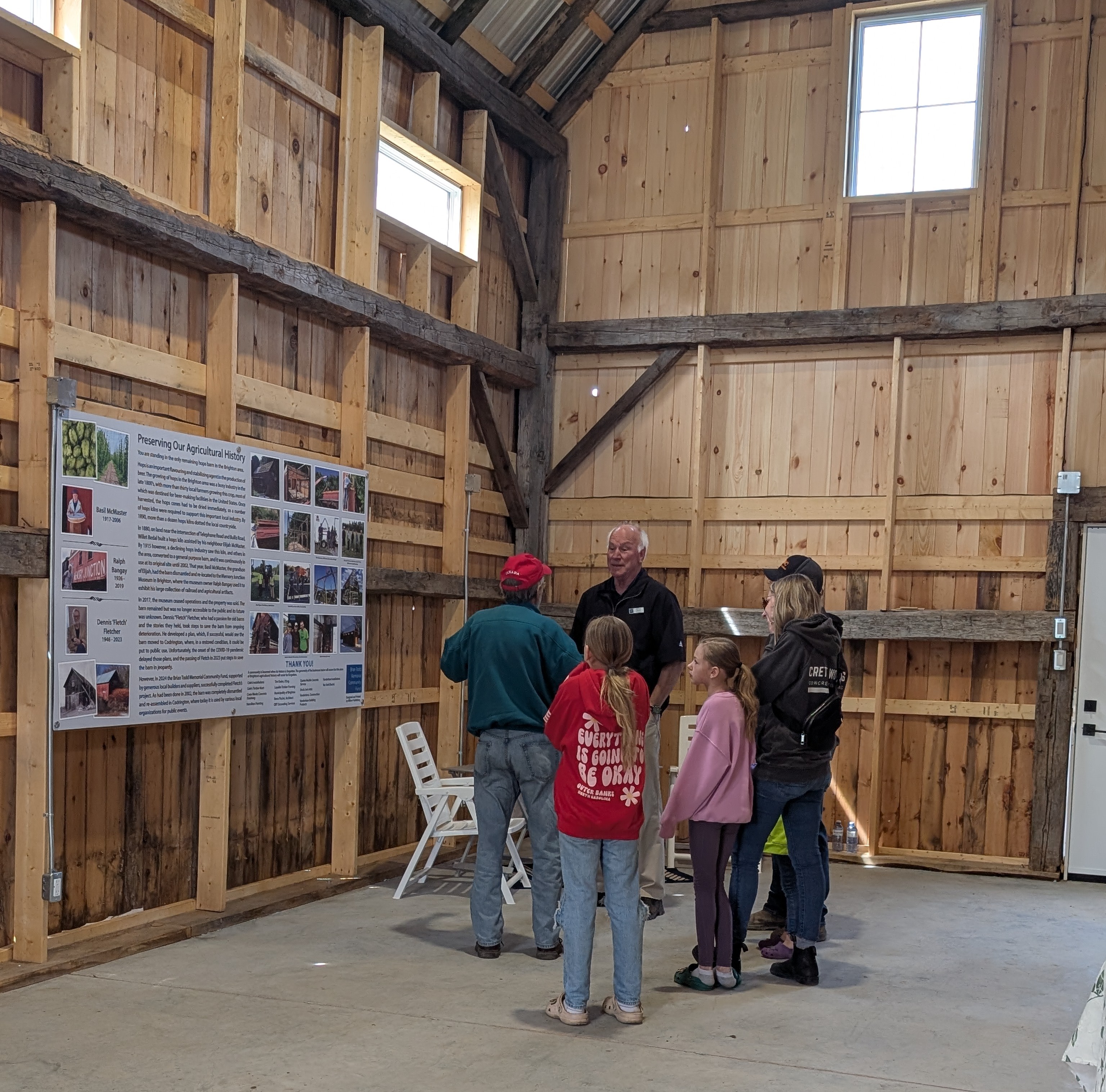
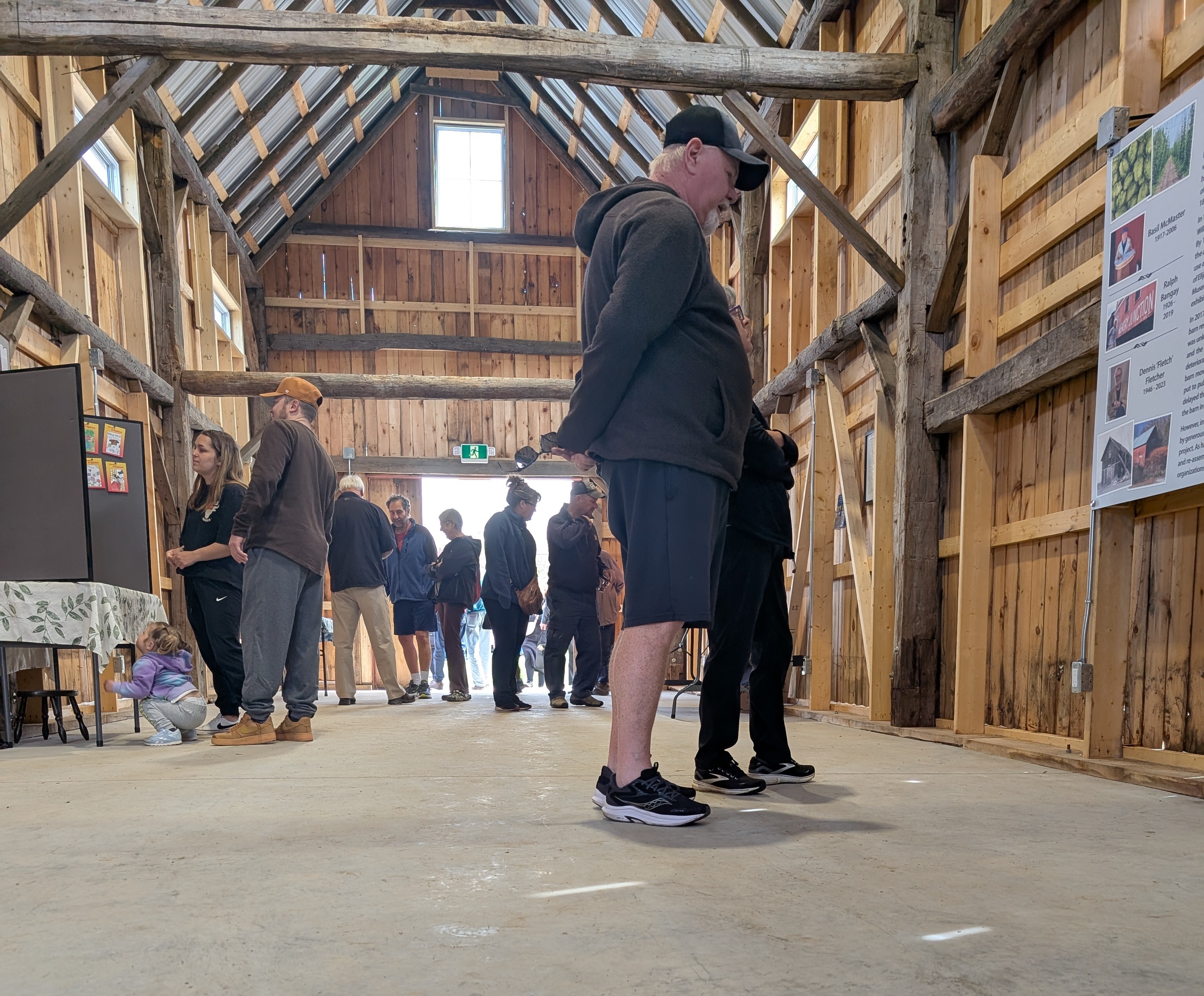
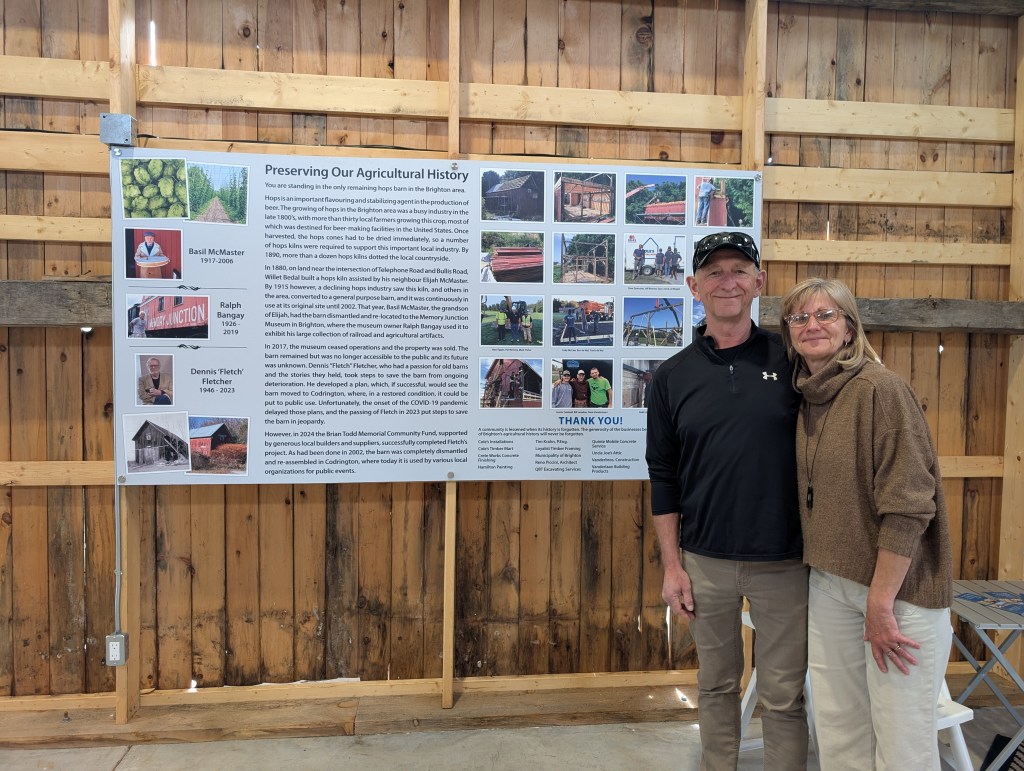
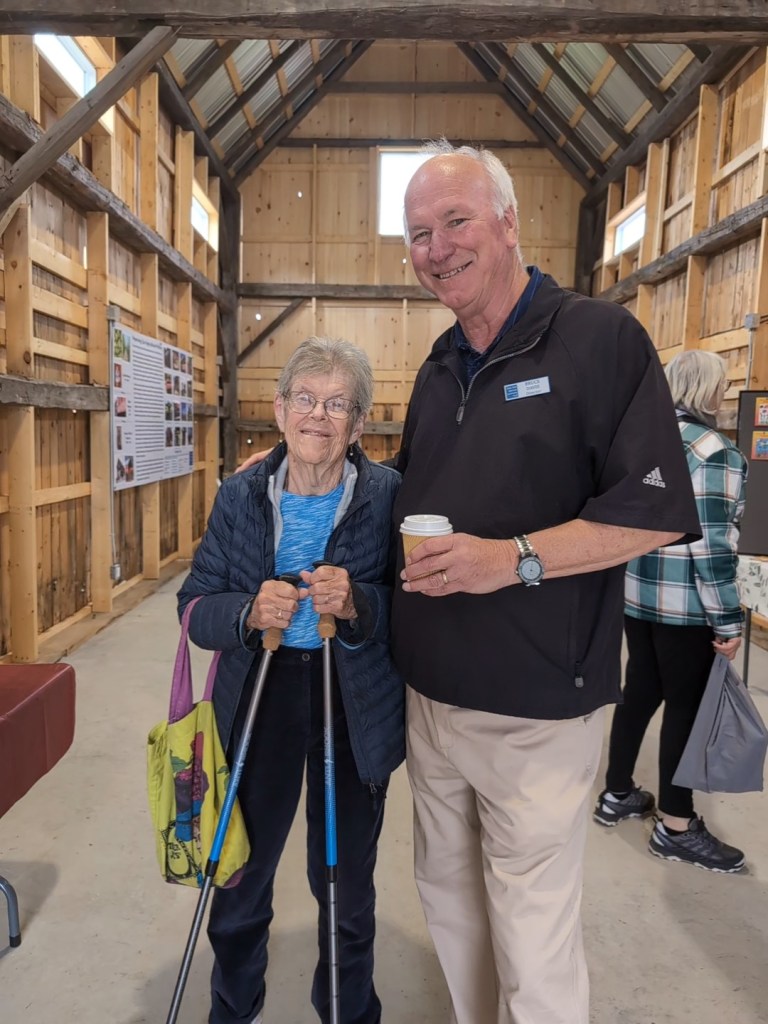
HOPS BARN OPEN HOUSE (May 4, 2025)
Everyone was invited to visit the recently relocated 145-year old hops barn during the opening weekend of the Codrington Farmer’s Market.
Directors of the Brian Todd Memorial Community Fund, who championed the project, will be on hand to share the barn’s history and describe how it was dismantled at the former Memory Junction Museum and re-assembled in Codrington.


A NEW COAT OF PAINT (May 12, 2025)
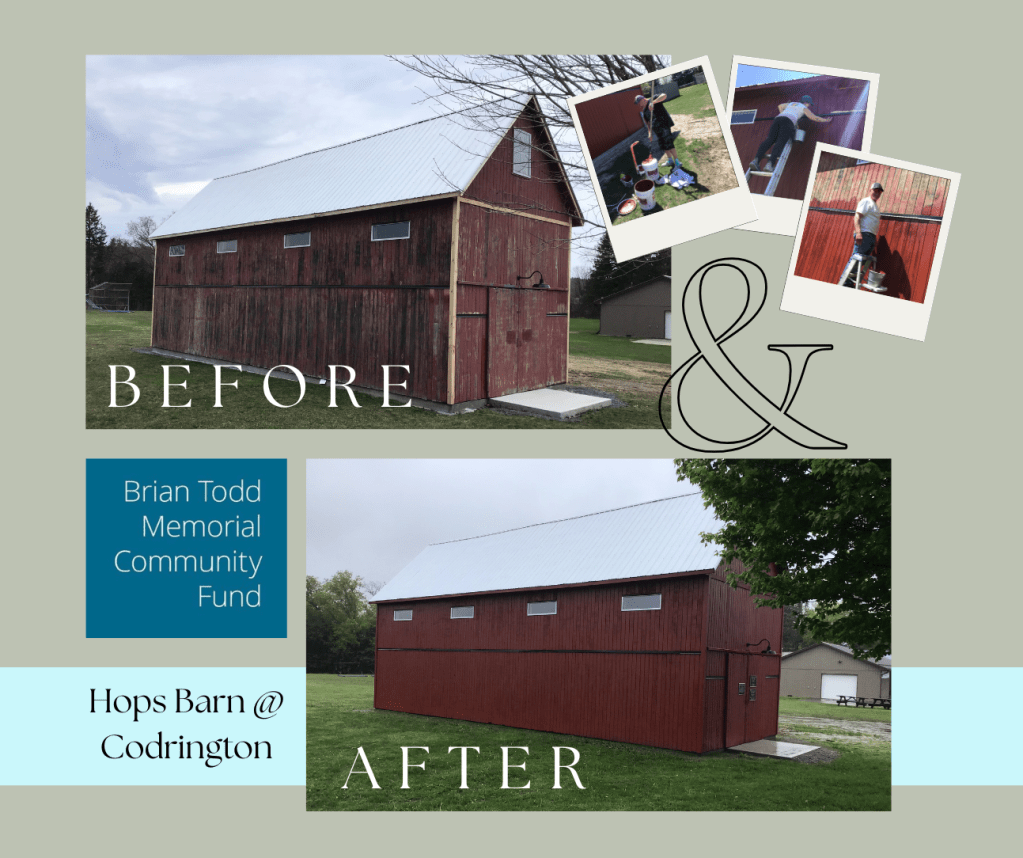
Many thanks to Megan, Kevin and “out-of-retirement’ Alex from Hamilton Painting for their meticulous work painting the structure in an appropriate shade of ‘Barn Red’!
IT’S OFFICIAL ~ HANDING OVER THE KEYS (June 4, 2025)
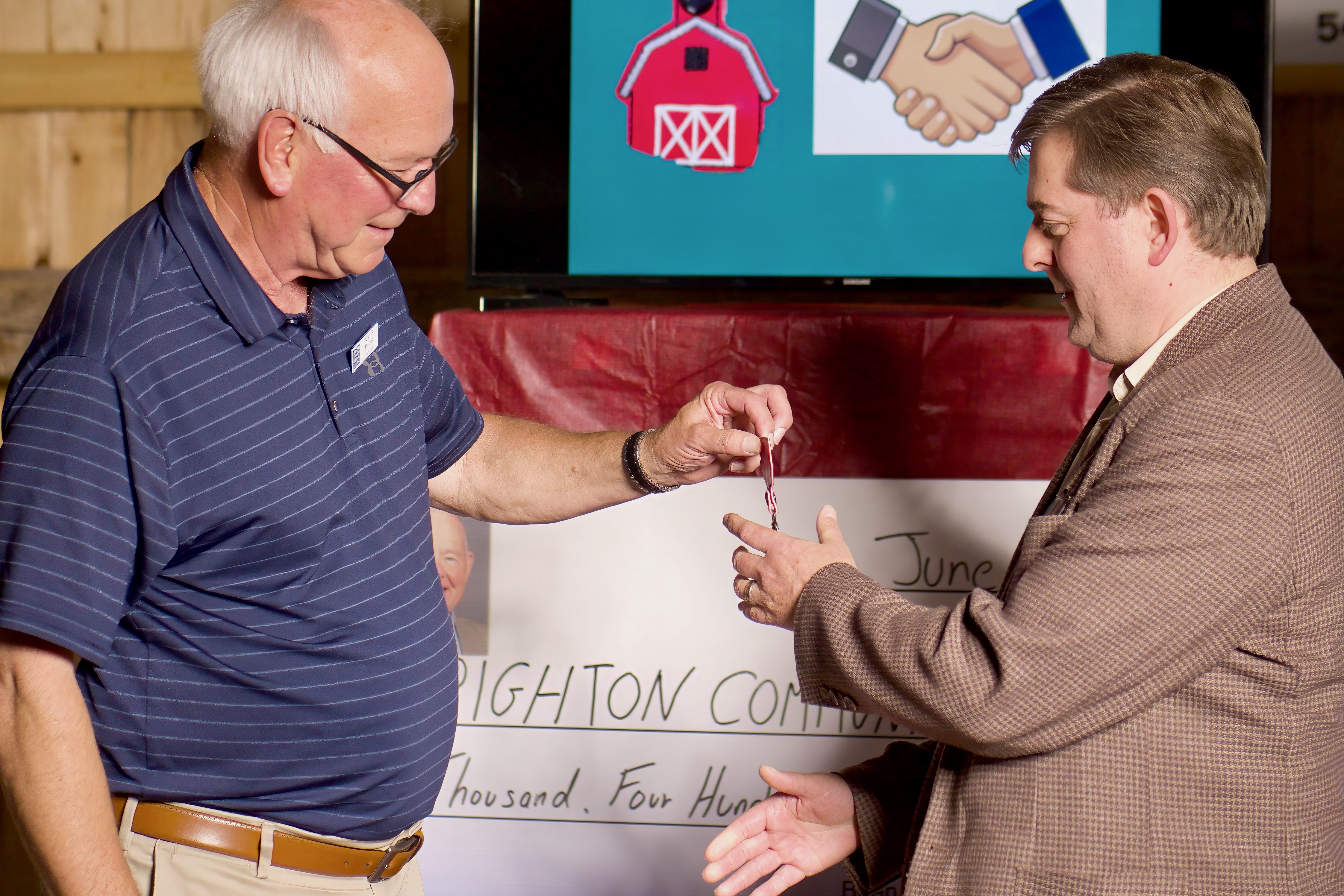
The BTMCF Board of Directors officially handed over the keys for the hops barn to the Municipality of Brighton. After close to two years of disassembling, moving and reassembling, the barn has been successfully relocated from its former Memory Junction Museum location to the playing fields of Codrington. BTMCF Directors are confident that, under the Municipality’s stewardship, this barn will quickly become a venue for many and assorted social activities, all the while preserving this important part of Brighton’s early agricultural history.

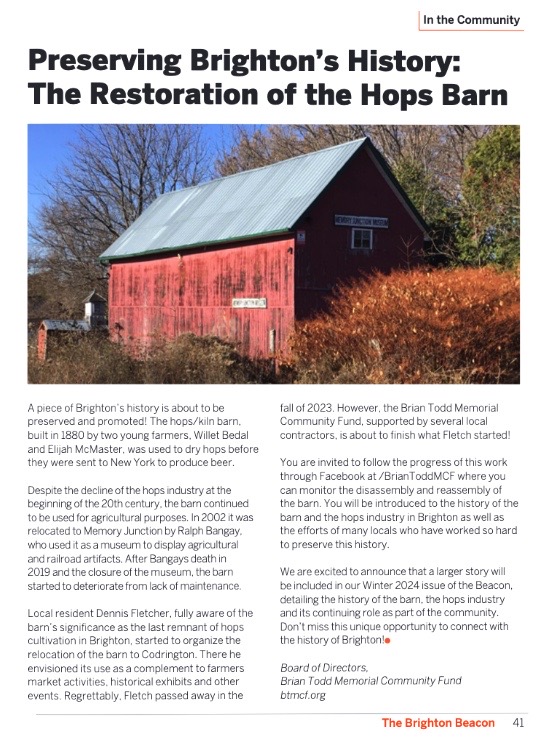
WRITTEN PUBLICATIONS about the Project
BrightonToday presents, “Join in the Journey as Brighton Makes History: Historic Hops Barn on the Move to Codrington” – Story by Sarah Hyatt, July 19, 2024
The Brighton BEACON presents, “PRESERVING BRIGHTON’S HISTORY: THE RESTORATION OF THE HOPS BARN” – Story by BTMCF Board of Directors, Fall 2024
BrightonToday’s COMMUNITY SPOTLIGHT presents, “A message from all of us on angel’s wings’: Brighton’s historic hops barn saved” – Story by Sarah Hyatt, November 27, 2024
WATERSHED Magazine presents, “THE RESTORATION OF BRIGHTON’S HOPS BARN” – Story by Timber Masterson, Spring 2025
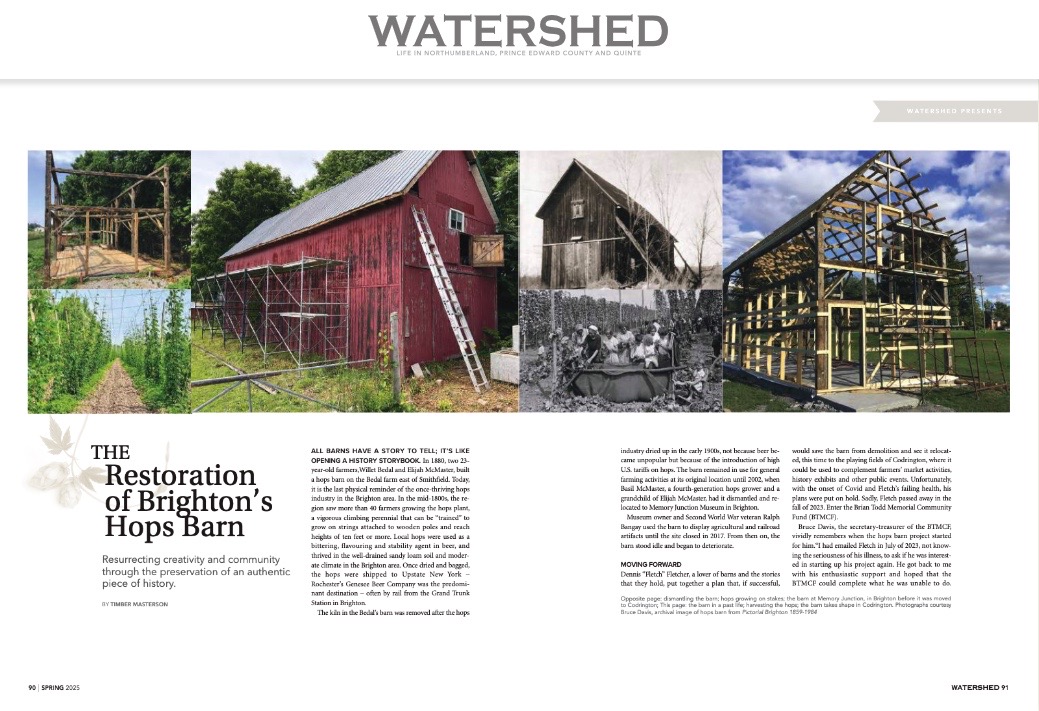
READ ‘The Restoration of Brighton’s Hops Barn’ by Timber Masterson, Watershed Magazine Spring 2025
WATERSHED Magazine presents, “IT TOOK A VILLAGE” – Story by Christopher Cameron, Summer 2025
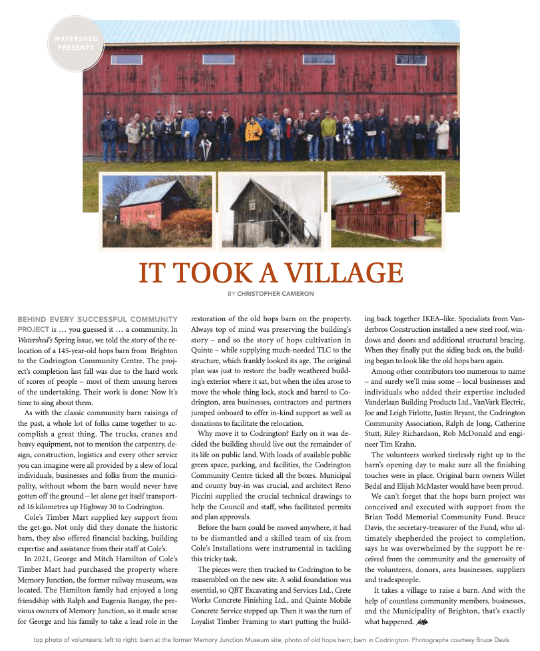
READ ‘It Took a Village’ by Christopher Cameron, Watershed Magazine Summer 2025
 Brian Todd Memorial Community Fund
You must be logged in to post a comment.